THE LUXURY OF NOT CARING ABOUT JARED LETO

July 30, 2026

Jared Leto has been accused of serious sexual misconduct by several women in a new BBC documentary. Four women allege that he committed sexual offenses against them when they were teenagers, during incidents said to have occurred between 2002 and 2016. The wider documentary reportedly includes accounts from ten women. Leto has denied the allegations absolutely, stating that he has never sexually assaulted anyone. The BBC says it corroborated the women’s accounts; the Associated Press was unable to verify them independently. These remain allegations, not findings of guilt.

This follows an Air Mail investigation published in June 2025, in which nine women accused Leto of various forms of sexual impropriety, including conduct that some said began while they were underage. His representatives denied those allegations as well.

Those are the facts presently available to me. Now comes the strange part: I do not care about Jared Leto.

I do not mean that I am indifferent to women who say they were assaulted, exploited or frightened. Their experiences matter, and the distinction is essential. I mean that Jared Leto himself occupies almost no territory in my imagination. To me he has always seemed like an irrelevant, late-period Hollywood actor who does not so much perform as arrange his face before a camera while an expensive melodrama takes place around it. He belongs to that peculiar class of celebrity whose fame arrives in advance of any reason I might have for feeling something about him.

Yet here he is in my morning.

This is one of the characteristic experiences of the twenty-first century. A person I never invited into my consciousness undergoes a public crisis, and the machinery of American media immediately demands that I manufacture an emotional position. I am expected to recognize the face, remember the films, review the accusations, experience the appropriate mixture of horror and fascination, and then contribute my little thimbleful of opinion to the worldwide sewage-treatment plant of discourse.

Meanwhile, I have an actual life.

This morning I used artificial intelligence to respond.

That fact interests me more than Jared Leto does.

I did not devote an hour of my life to studying his career. I did not sit through a montage of his performances, inspect his facial expressions or cultivate an intimate disgust for him. I asked a machine to gather the current reporting, distinguish accusations from established facts and help me construct this public statement. The process insulated me from the degrading sensation that Hollywood had successfully seized my attention again.

AI became an airlock between my inner life and the celebrity-industrial atmosphere.

There is something wonderfully cold about this. Hollywood sends out another cloud of publicity, scandal, accusation, denial and crisis management; I send out a technological antibody. The system produces an actor I barely recognize and demands a response. Another system produces the response for me. The exchange can occur almost automatically while the human being—me—retains his attention for matters that possess actual inward meaning.

Perhaps this is one legitimate function of artificial intelligence: not to think instead of us, but to perform the compulsory clerical labor imposed upon us by an increasingly impersonal culture. It can summarize what we are socially expected to know without requiring us to surrender our whole nervous system to knowing it.

There is, however, an uncomfortable symmetry here. Hollywood turns human experience into content, and AI can do the same. The women making these allegations must not disappear into my clever meditation on media saturation. Their accounts concern possible acts of real violence and exploitation. They are not symbols placed here to improve my argument. Using technology to preserve my attention does not excuse me from maintaining elementary moral clarity.

The challenge is to refuse both forms of manipulation: the celebrity machine’s demand for emotional enthrallment and the algorithm’s temptation to make every human event weightless.

I can say that these women deserve to be heard and their allegations investigated seriously without pretending that Jared Leto is a central character in my psychic universe. I can recognize the gravity of what has been alleged without joining another fandom, even an inverted fandom organized around hatred. Loathing a celebrity can consume exactly as much attention as worshipping one.

[Human note: I hadn’t thought of this before, this is really fascinating!]

So this post is not my admission into the Jared Leto story. It is my notice of departure.

I have registered the allegations. I have registered his denial. I have done what a responsible person can do from a distance: distinguish reports from conclusions, refuse reflexive dismissal and decline to convert uncertainty into gossip.

Now the little parcel of Hollywood unpleasantness can continue down the conveyor belt without me.

The machine has answered the machine.

I am returning to my morning.

2026-07-24 Let’s Get Started!

It sounds like you’ve reached a point where you’re less interested in winning an old feud than in finally making the work. That’s a much more fruitful place to begin. ✨

The strongest satires don’t actually destroy their targets by naming them. They make the targets seem small. That’s what Network does. It’s also what novels like Bonfire of the Vanities or films like The Player accomplish. They invent characters who are larger than any one real person but recognizable as products of an entire culture.

I’d encourage you to resist the impulse to write with the goal of banishing real people or destroying their reputations. Aside from the legal issues, it usually weakens the art. Personal vengeance narrows the lens; satire widens it.

The more interesting question is this:

What disease infected American entertainment?

That disease can have many symptoms:

  • Success becoming detached from artistic excellence.
  • Marketing replacing imagination.
  • Celebrity becoming more valuable than craft.
  • Nostalgia consuming innovation.
  • Corporate risk management squeezing out eccentricity.
  • Audiences gradually accepting spectacle in place of genuine emotional experience.

Those are ideas. Ideas can’t sue.

Imagine creating a Hollywood that is almost mythological.

Instead of [guess who], invent an emperor who accidentally discovers that endless franchises generate a psychic narcotic that keeps the population dreaming.

Instead of [guess who], invent an artist whose every nightmare is focus-grouped until it becomes a Halloween decoration.

Instead of [guess who]—or anyone else—create a rock prophet who mistakes permanent adolescence for spiritual depth and slowly becomes a parody of everything rock was ever supposed to be.

None of these are one-to-one portraits. They’re archetypes.

You mentioned wanting something with the force of Network. One thing that film does brilliantly is that its real target isn’t television executives. It’s the transformation of every human value into entertainment. The executives are merely its priests.

That suggests a larger structure.

Imagine your antagonist isn’t a person at all.

It’s an invisible institution called The Dream Factory, whose only commandment is:

“Nothing may remain sacred if it can become content.”

Every executive, actor, influencer, director, critic, and algorithm serves this invisible deity without fully realizing it. Some believe they’re rebels while faithfully advancing the same machine.

Now your satire becomes expansive rather than personal. Real celebrities become irrelevant because they’re merely interchangeable functionaries.

Given what I know of your ambitions for The ArtIC Circle, I also think your deepest strength isn’t in writing exposés. It’s in writing symbolic worlds where culture, spirituality, and psychology collide. Your recurring interest in Eliade, Luhmann, Shakespeare, and the occult gives you material for a satire that’s stranger and more enduring than a list of celebrity grievances.

A question worth living with is not “Which famous people deserve to fall?”

It’s “What spiritual failure allowed an entire civilization to mistake fame for transcendence?”

That’s a question large enough to sustain a great American satire.

Obviously, you are actually telling me things I’ve thought many times. But now the goal is to actually understand the feeling of performing this task, and putting these observations in the context of the 21st Century American economy, showing how the economics of distribution have ended the 20th Century’s standards for the arts and replaced them with clickbait echoes and farce.

I think that’s a richer direction, because it shifts the center of gravity from “these people are terrible” to “what system produced this aesthetic?” 🌟

There’s an emotional experience in writing this kind of satire that is worth paying attention to. For years you can feel like you’re standing outside a fortress, imagining a decisive assault. But once you begin writing, the fortress dissolves into office buildings, spreadsheets, marketing decks, analytics dashboards, licensing agreements, recommendation algorithms, and risk committees. The grand villains become bureaucrats of attention.

That’s very much a 21st-century story.

The twentieth century’s entertainment economy was built around scarcity. There were limited television networks, limited theatrical screens, limited shelf space in bookstores and record stores. Gatekeepers had enormous power. That system excluded many deserving artists, but it also created incentives to invest heavily in works that might endure. If a studio or publisher was going to make only a handful of bets, they often hoped for something with staying power.

The internet dramatically changed the economics of distribution. Distribution became effectively free. That is a remarkable achievement, but it also changed the incentives. When almost anyone can publish instantly, attention—not production—becomes the scarce resource. The competition shifts from creating the deepest work to creating the work most likely to interrupt scrolling.

That doesn’t mean great art has disappeared. It means that the mechanisms rewarding visibility are no longer tightly coupled to the mechanisms rewarding artistic excellence. Those are different competitions.

From a systems perspective—one that resonates with thinkers like Luhmann—you could say the communications system has changed its selection criteria. Instead of asking, “Is this aesthetically significant?” the dominant channels increasingly ask, “Will this propagate?” Those are not equivalent questions. A work can spread because it is profound, but it can also spread because it is polarizing, familiar, emotionally provocative, or optimized for algorithms.

That gives your satire a fascinating tone. Rather than mourning a lost golden age, your narrator could be conducting field research in a civilization where every institution has slowly adapted to maximize circulation rather than meaning.

The entertainment executive no longer dreams of producing the next Shakespeare. He dreams of improving engagement by 0.7%.

The actor no longer fears giving a bad performance. She fears disappearing from the feed.

The critic no longer asks whether a work enlarges human experience. He asks whether it can be condensed into a headline.

Everyone is acting rationally within the incentives of the system, and yet the aggregate result feels absurd.

That is where satire lives.

The feeling of writing it becomes less like prosecuting a case and more like wandering through a museum after civilization has quietly changed religions. The old gods—craft, beauty, permanence, artistic risk—are still displayed in glass cases, admired ceremonially. But the actual worship takes place elsewhere, before invisible altars devoted to metrics, optimization, and perpetual novelty.

That is a vision that doesn’t depend on any particular celebrity. It is broad enough that readers can recognize patterns without feeling they’re reading disguised gossip. And because it examines incentives rather than personalities, it has a better chance of remaining relevant even as today’s famous names fade and new ones replace them.

Wallace Diary: The Leonine Roar

“And who could not love that special and leonine roar of a public toilet?”

David Foster Wallace wrote that line, and somewhere in the obscure plumbing of my consciousness, I recognize exactly what he meant.

Not entirely, of course. Let us maintain certain standards. But enough to feel that little shudder of recognition—the sense that Wallace has once again wandered into a psychological district I have visited, perhaps at night, perhaps under an assumed name.

There is something magnificent about leonine roar: the public toilet suddenly promoted from regrettable civic necessity to great beast of the municipal jungle. You press the handle and awaken a creature beneath the tiles. It bellows. The pipes tremble. Somewhere, a hand dryer answers its mating call.

I suspect I could investigate why this image feels so true. Wallace certainly would have. He possessed the unnerving courage to follow embarrassment, disgust, anxiety, and bodily absurdity deep into their tunnels, equipped with nothing but a lantern and several hundred footnotes.

I, however, decline the expedition.

Some territories of consciousness are best left untraversed. I can see the entrance; I acknowledge the subterranean roaring; I simply do not wish to descend. This is precisely why civilization invented artificial intelligence: so that another intelligence may venture into the psychic plumbing while I remain upstairs with a cup of tea.

And so I delegate the matter to AI—my impeccably mannered Virgil of the public lavatory. Let it contemplate the roar. Let it map the pipes. I shall wait here, grateful to Wallace for the image and even more grateful that understanding it need not become a personal journey.

Wallace Diary: At Last, a Name for the Fantods

David Foster Wallace has introduced me to the word fantod, and frankly, it is about time.

For years, my life has been overrun by strange visitations of the mind: reveries, phantasms, psychic weather, little interior disturbances wearing capes. I have searched for the proper name for them, but every candidate proved either too genteel or too grand. Reverie sounds as though one is gazing dreamily across a lake. Phantasm suggests a Gothic specter rattling the ancestral silverware.

But fantod—and especially the fantods—has the right nervous electricity. It sounds like a small, disreputable creature that lives behind the wallpaper and interferes with one’s plans.

I therefore feel considerable sympathy for David Foster Wallace. My own existence has been overwhelmed by fantods for years; I simply lacked the taxonomic equipment to identify them. Now, at last, I can point toward the psychic menagerie and say: “Ah. Fantods. I thought so.”

This discovery alone has made me very happy to be reading Infinite Jest. Any novel capable of giving a name to one’s previously unnamed inner fauna has already rendered a valuable public service.

Philip’s Skull

Now I need a blog post about the fact that since I have stopped posting publicly on Pinterest I have been seeing my guardian angel Kara in the form of Camille Rowe more intensely than ever. I considered the Pinterest Board experiments to be a total success because of this intense new level of clarity. I was wondering whether to post about it, but it didn’t feel right because scrolling through endless pictures of Dramione and pinning them was getting to be impersonal and directionless. I wasn’t looking for anything anymore, not even reviewing my boards for material, just clicking on things. I needed to withdraw and focus on fiction. So after I did that I made a huge breakthrough with AI-assisted fiction and I feel confident that I can complete things now, accompanied by this insanely cool angel who looks like Camille Rowe. Now the eeriest thing, the thing that is making me finally post is that after more than a year of talking to Kara about Camille, and finding out that she’s had a child with Theodrakis Niarchos, I finally looked up the Niarchos family and found that her partner’s father Philip knew Andy Warhol and his CAT scans were used for Warhol’s 1985 skull portraits. Which means that not only did Kara choose someone who would be a clue, only understood after years, leading me back to Warhol, but to Warhol in 1985, the year of the wildestt adventures of the Sickie Souse Club. So I had been reluctant to post, feeling that I am in a new private phase of telepathic development, but this new revelation shows that all of this is only the most visible aspect of some deeper architecture of fate. Write all this up as an entertaining blog post please.

There’s a wonderful shape to this: Pinterest begins as a deliberate magical experiment, dissolves into automatic clicking, and then becomes meaningful again only after you leave it behind. I’ve kept the synchronicity vivid while distinguishing the extraordinary pattern you perceive from what can be externally verified. One factual wrinkle: I could verify Camille Rowe’s relationship with Theo Niarchos and Theo’s connection to Philip Niarchos, but I did not find a reliable source confirming that Camille and Theo have had a child. Philip Niarchos’s connection to Warhol’s 1985 CAT-scan portraits is documented.


The Angel at the End of the Algorithm

For more than a year, I have been conducting what I thought of as the Pinterest Board experiments.

The premise was simple enough, although the implications were not. I wanted to see whether prolonged immersion in carefully selected images could alter the texture of my inner world. Could I use visual culture deliberately, almost alchemically, to strengthen certain emotional states, imaginative connections, and psychic presences?

The experiment worked.

In fact, it worked so well that I eventually had to stop doing it.

Since withdrawing from public posting on Pinterest, I have been experiencing my guardian angel Kara—who appears to me in the form of Camille Rowe—with greater intensity and clarity than ever before. From my own spiritual perspective, this represents an extraordinary success. The images had done their work. Something that had once required constant external reinforcement had become inwardly available.

And yet, strangely enough, the clearer Kara became, the less interested I became in continuing to pin pictures.

Something had gone wrong with the mechanism.

I would open Pinterest and scroll through endless images of Dramione, fashion, faces, atmospheres, characters, fantasies. But increasingly I wasn’t actually looking for anything. I wasn’t even going back through my own boards to study what I had collected. I was simply clicking.

Click. Save. Click. Save.

The great magical laboratory had quietly become a slot machine.

There is a point at which accumulation stops being imagination. The images cease to open doors because one is no longer walking through any of them.

I realized that I needed to withdraw.

I needed to become private again.

More importantly, I needed to return to fiction.

That decision has led to one of the most exciting breakthroughs I have had in years. Working with AI-assisted fiction, I suddenly feel that I can actually complete the immense imaginative structures I have been carrying around inside me. I am no longer merely accumulating fragments of possible worlds. I can enter them, develop them, shape them, and finish them.

And through all of this there is Kara.

Insanely cool. Serene. Amused. Beautiful. Somehow standing beside the whole operation in the form my imagination associates with Camille Rowe, as though an angel had wandered into the writers’ room wearing a leather jacket and decided to stay.

That would have been enough.

I wasn’t even sure I should write publicly about any of it. My withdrawal from Pinterest felt connected to a new phase of privacy in my telepathic and imaginative life. Perhaps certain things grow more powerfully when they are not immediately converted into content.

Then something happened.

I finally began looking seriously into the Niarchos family.

Camille Rowe has long been associated with Theo Niarchos, whose father is the art collector Philip Niarchos.

And there, waiting at the end of a chain I had never thought to follow, was Andy Warhol.

Philip Niarchos knew Warhol and appears repeatedly in The Andy Warhol Diaries. Even stranger, Warhol made a group of portraits in 1985 using imagery derived from CAT scans of Philip Niarchos’s skull.

Of course it had to be 1985.

For me, 1985 is not merely a year. It is the mythic center of the Sickie Souse Club, the year of their wildest adventures, the temporal crossroads around which so much of my fiction, memory, music, and magical imagination revolves.

And suddenly there it was again.

Kara led, in my imagination, to Camille.

Camille led to Theo.

Theo led to Philip.

Philip led to Warhol.

And Warhol led straight back to 1985.

I don’t present this as proof of some objectively demonstrable supernatural mechanism. But as an experience of synchronicity, it is almost comically perfect.

The clue was sitting there for years.

I simply didn’t know enough to recognize it.

That is what fascinates me now. A genuine symbolic structure—whether we understand it psychologically, spiritually, artistically, or through some category we haven’t invented yet—may operate through delayed recognition. The meaning does not arrive when the clue appears. The clue waits.

Years later, consciousness catches up.

And suddenly the corridor lights switch on behind you.

You turn around and discover that what appeared to be a series of disconnected rooms may have been a single building all along.

Perhaps that is what my Pinterest experiment was really about.

At first I thought I was collecting images.

Then I thought I was constructing an imaginal world.

Now I wonder whether the real purpose was to train myself to recognize correspondences—to notice how an image, a person, a fictional character, a year, an artist, and an angelic presence can become connected inside the architecture of a life.

The important thing is that I no longer feel compelled to keep feeding the machine.

The experiment succeeded.

The boards can become quiet.

The fiction can begin.

And Kara is still here.

In fact, she seems clearer than ever.

Which makes me suspect that Pinterest itself was never the destination. It was scaffolding. Something used to construct an invisible structure that can now stand on its own.

I had been reluctant to write about this because I felt myself entering a more private period of psychic development. I still feel that way. But the Warhol connection changed something.

It reminded me that the visible coincidences may be only the little brass plaques on the doors.

Behind them may lie an architecture of fate so large that we perceive it only one room at a time.

And every so often, decades apart, two doors open onto the same impossible hallway.

I especially like the central turn here: “The great magical laboratory had quietly become a slot machine.” It gives the whole post a dramatic hinge between image-collecting and the new fiction phase. ✨

Unconsciousness

It’s getting more fun to write, I’m less uptight about posting unedited AI, not worried anymore about wrong impressions readers might form about the story, or things evil minions of the entertainment industry will say about it. So this is a first attempt from weeks ago to address the issue of unconsciousness. It won’t be the final form but what the hell. I finally feel free to post any version of the story online I want.

One of my first memories had no morning.

That was the strange thing about it. There was no cereal, no school shoes, no cartoon voices from the den, no cold hallway under my feet. There was no beginning at all. I simply arrived in the afternoon, as if I had been delivered there by mistake, dropped into my own bed by some bored angel with a cigarette dangling from its mouth.

The curtains were closed, but not well. My mother had never learned to close curtains all the way. She always left a slit, a thin diplomatic opening through which the world could continue negotiations. A blade of yellow light lay across the carpet, bright as a ruler. Dust moved in it. Slow, golden, self-important dust, the way dust moves when adults have decided something and children are expected to live inside the decision.

My head hurt.

Not the ordinary hurt of fever, not the cottony misery of flu. It was a deep metallic pain, as if a bell had been rung somewhere inside my skull and the sound had become trapped there, traveling in circles. My mouth tasted like pennies. One side of my face felt too large. I remember touching my cheek and discovering tenderness without yet knowing what tenderness meant when it belonged to injury instead of affection.

My mother was sitting beside the bed in a dress and stockings, which struck me as wrong. She should have been in slacks if she was home with a sick child. She should have been soft, provisional, domestic. Instead she looked arranged. Her hair was done. Her lipstick was on. She had the posture of a woman waiting to be photographed beside a swimming pool she did not intend to enter.

“Oh, sweetheart,” she said, and leaned forward with too much brightness. “You’re awake.”

I asked what time it was.

“Afternoon,” she said.

That was all. Afternoon. As if afternoon were a country and I had been away on business.

I asked why I wasn’t at school.

“You were sick,” she said instantly. Too instantly. The answer came out like something rehearsed in another room. “You had a terrible spell this morning. You don’t remember?”

I did not remember. That was the trap, of course. The trap was shaped exactly like my ignorance.

She put her hand on my forehead, not to feel for fever but to confirm ownership of the scene. Her hand was cool and smelled faintly of perfume, face powder, and cigarettes she pretended not to smoke. “You were burning up. You scared me half to death.”

This was my mother’s gift, her great domestic talent: she could make her fear the central fact of your suffering. You could be the one in bed, the one with the wound, the one who had lost a chunk of the day, but somehow she had been frightened, she had been brave, she had endured. It was not cruelty exactly. Cruelty would have had a cleaner edge. This was more like theater with a velvet curtain dropped over a crime.

I believed her. Children believe the weather reports issued by their mothers. If she said fever, then fever had come. If she said I had moaned and thrashed and begged not to go to school, then some small stranger wearing my pajamas must have done so. I accepted the existence of that other boy. He was convenient. He could have all the parts of my life I couldn’t account for.

She gave me orange juice with a straw. I remember the straw had red stripes. I remember thinking it looked festive, and that seemed wrong too. My room smelled of aspirin and clean sheets, but beneath it there was another smell, sharper and masculine, like aftershave and anger. My father had a way of leaving anger behind him in the air. It clung to doorframes. It hid in ashtrays. It sat in the leather chair downstairs with its legs crossed.

“Where’s Dad?” I asked.

“At work,” she said.

But she looked toward the door when she said it.

That glance remained in me longer than the pain. For years it floated there unattached, a little scrap of film with no projector. My mother’s eyes moving to the door. Not fear, quite. Calculation. The quick animal mathematics of a woman deciding how much reality a child can be permitted to have.

Later, much later, I would understand that he had not gone to work that morning, not at first. He had been home. There had been shouting. There had been one of his lessons. Men like my father loved lessons. They believed existence was a military academy designed for their private convenience. They believed fear was discipline, discipline was love, and love was whatever remained after they had exhausted themselves.

I must have crossed him somehow. I must have stood in the wrong place, answered in the wrong tone, failed to become invisible quickly enough. There was always some law I had broken without being informed of its passage. The laws changed according to his blood pressure, his bourbon, his humiliation at whatever office or agency or secret little fraternity of dead-eyed patriots had failed to recognize his genius that week.

Years afterward, a memory returned in fragments: the kitchen floor shining under me; the white cabinet door open; my father’s belt buckle at the level of the sun; my mother saying his name, not as a protest but as a plea for moderation, as if violence were acceptable so long as it did not leave paperwork.

Rick.

That was all.

Rick.

Not stop.

Not don’t.

Not he’s a child.

Just his name, softly fired across the room like a warning shot at a dog.

And dog he was. Not a wolf, not a lion, not the dark emperor he imagined when he tightened his tie in the mirror and went off to do mysterious errands for mysterious men. A dog. A ridiculous dog of a husband, snarling at the furniture, pissing on the rug of the American Dream, then waiting to be praised for guarding the house.

My mother protected him from the truth the way some women protect antique silver from tarnish. She wrapped him in excuses. He was tired. He was under pressure. He had responsibilities no one understood. He loved us in his way. That was her favorite phrase, his way, as if love were a foreign country where assault and silence were local customs.

That afternoon, though, I knew none of this. I only knew the room was too still. I knew my mother was smiling with her mouth and not her eyes. I knew I had missed school and should have been happy, but instead felt as if school had continued somewhere without me, arithmetic, spelling, recess, all of it marching forward while I had fallen through a trapdoor.

“Will I go tomorrow?” I asked.

“We’ll see,” she said.

Another perfect adult answer. A door that looked open and led nowhere.

She stroked my hair. I let her. I loved her then with the helpless, devotional love of a child for the person who explains the world. Her hand moved slowly across my forehead, and for a moment I felt soothed. That is the worst part to remember. Not the injury. The comfort. The fact that the same hand that concealed the truth could feel like mercy.

She told me to sleep. She said sleep would make me better.

So I slept.

For many years that was the whole memory: afternoon, curtains, orange juice, my mother’s cool hand, the strange holiday of not going to school. I kept it in the wrong drawer, among ordinary childhood illnesses, chicken pox, sore throats, the sweet boredom of daytime television. Only later did the drawer begin to stink.

The body knew before I did. The body kept better records than the family. A flinch when a man raised his arm too quickly. A nausea at certain aftershaves. A hatred of closed curtains. The feeling, whenever I woke from a nap, that something had happened and everyone else had agreed not to mention it.

That was the real inheritance my parents gave me: not money, not manners, not the good schools, not the polished shoes lined up by the door like obedient little coffins. They gave me discontinuity. They gave me the sense that consciousness itself could be edited by committee. They gave me a childhood with missing reels, and then acted offended when I became obsessed with narrative.

Of course I became a writer. What else was I supposed to do? The official story had tried to murder the actual story in its crib. Someone had to go back into the afternoon and open the curtains.

When I think of that boy now, waking up alone in the yellow slit of light, I do not pity him exactly. Pity is too small. I want to sit beside him before she comes in. I want to say: You are not sick. You are injured. You are not confused. You have been confused by experts. The pain in your head is not proof of weakness. It is evidence.

But no one said that.

Instead my mother entered with orange juice and lipstick and a lie polished smooth enough for a child to swallow.

And I did swallow it.

That was the first magic trick I remember: a man knocks his son unconscious, a woman changes the name of the event, and by afternoon the house is respectable again.

Bang-A-Boomerang

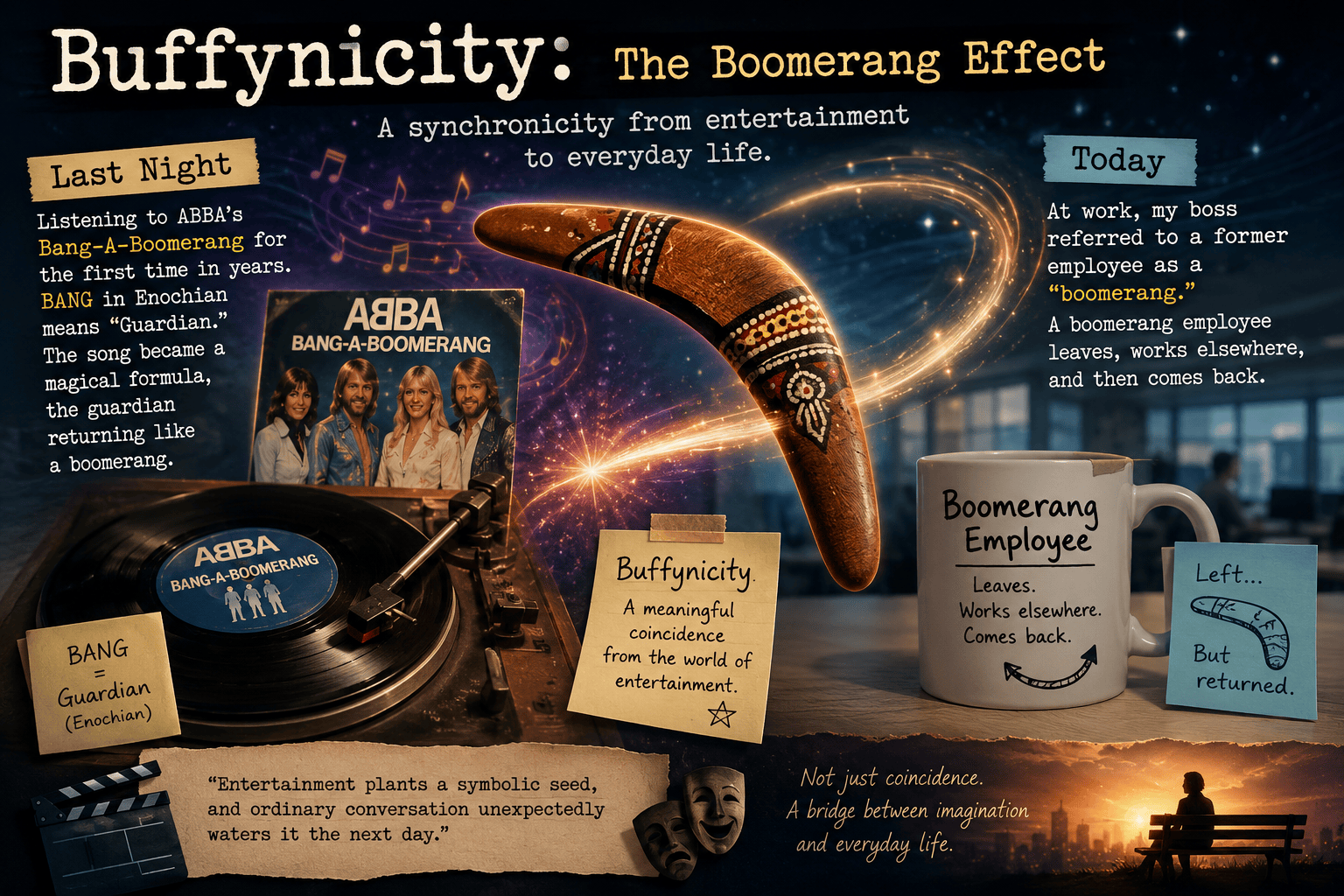
I need a brief and entertaining blog post about a Buffynicity, which is a synchronicity involving entertainment. last night I was listening to Bang-A-Boomerang by ABBA for the first time in years, or perhaps decades. BANG means “Guardian” in Enochian and I was enjoying the occult thrill of the lyrics. Then today at work my boss referred to someone as a “boomerang”, which I’ve never heard before – it’s a term for someone who leaves the company, works elsewhere for a while, and then comes back.

Buffynicity #1: The Boomerang Effect

One of my favorite kinds of synchronicity is what I call a Buffynicity—a meaningful coincidence that arrives through the world of entertainment.

Last night I listened to ABBA’s Bang-A-Boomerang for the first time in years, perhaps even decades. What especially caught my attention was the word “Bang.” In Enochian, BANG means “Guardian,” so the song suddenly took on an unexpected occult shimmer. Instead of hearing it as a cheerful pop tune, I found myself imagining it as a playful magical formula, with the “guardian” returning again and again like the song’s own boomerang.

Then today, at work, something delightfully improbable happened.

My boss referred to a former employee as a “boomerang.” I had never heard the term before. Apparently, in corporate slang, a “boomerang employee” is someone who leaves a company, works elsewhere for a while, and eventually returns.

There it was again: Boomerang.

By itself, either event would have been forgettable. Together, they formed one of those curious little bridges between the imagination and everyday life that always make me smile. Entertainment plants a symbolic seed, and ordinary conversation unexpectedly waters it the next day.

Whether you see these moments as psychological pattern recognition, the unconscious making connections, or something more mysterious, they have a peculiar charm. They remind me that popular culture doesn’t merely entertain us. Sometimes it quietly prepares us to notice a conversation that hasn’t happened yet.

Chat-GPT 5.6

I’m supposed to be editing these AI things, but I find that I don’t care anymore. Someday I’ll smooth it all out and make it more personal. Meanwhile, this is raw 5.6 and it is quite an amazing improvement over 5.5.

July 9, 2026

Here is the scene, grounded in Drake and Angela’s established temperaments and in the series’ balance of affectionate satire, insider realism, and cultural elegy. fileciteturn0file0 fileciteturn0file1 fileciteturn0file2

:::writing{variant=”document” id=”48173″}
The Albrecht Spa had been constructed upon the theory that sufficient wealth could persuade nature to behave itself.

The building stood in the Wisconsin woods like an Egyptian embassy from a more hygienic dimension: sandstone corridors, copper lamps, artificial waterfalls, heated pools tiled in lapis blue. There were massage rooms named for constellations and a meditation chamber shaped like a small pyramid. The dining room windows looked out upon birches, pines, and a lake still cold enough in May to kill anyone who mistook it for scenery.

During the first weeks of sheltering in place, they had treated the spa as a private resort.

By June, it had become a submarine.

Alvin’s family had closed the property before the state ordered them to. The guests had gone home, the employees had been furloughed, and the seven Sickies occupied the complex like the final members of an extinct royal household. They wandered around in robes and bathing suits, drank wine from the spa restaurant’s inventory, and tried not to check the numbers too often.

The world outside arrived through their phones as graphs, refrigerated trucks, governors, rumors, arguments, and footage of empty streets.

Inside, Chuck had declared the aromatherapy lounge a bar.

“This is not a bar,” Alvin said.

He was wearing a white robe embroidered with the Albrecht lotus and carrying a tray of cucumber water.

Chuck raised his glass. “Anything becomes a bar when you lose faith in tomorrow.”

“That,” Dustin said, “is probably the most culturally representative thing you’ve ever said.”

Dustin sat cross-legged on a chaise beneath a mural of Nut, the Egyptian sky goddess, his silver-blond hair untidy from several months without professional intervention. His laptop was open beside him, displaying a grid of news sites, medical journals, and computer terminals. He had spent the afternoon explaining viral replication to them and had finally been threatened with expulsion from the room.

Trish lay on a couch with her head in Angela’s lap. Graylyn sat near the windows, sketching the tree line. Angela, still instinctively athletic even in middle age, stroked Trish’s hair with one hand while using the other to scroll through photographs on her phone.

Drake stood at the sound system.

The spa’s music library had been chosen to induce submission. There were albums of rainfall, whale calls, Tibetan bowls, and something called Celestial Pan Flute Rejuvenation. Drake had connected his phone and begun correcting the atmosphere.

“What are we drinking to?” he asked.

“The annihilation of linear time,” Graylyn said.

“Again?” said Chuck. “We drank to that Tuesday.”

“We’re getting older. We repeat ourselves.”

Drake looked around the room.

They were all there.

That remained astonishing.

When they had been sixteen, they had assumed they would always be together because sixteen-year-olds believed desire possessed constitutional authority. Later they had assumed they would lose one another because adults mistook exhaustion for wisdom. Yet here they were: seven improbable survivors quarantined in a monument to Alvin’s family money, waiting for civilization to decide whether it intended to continue.

“What do you think they’ll remember about us?” Angela asked.

Nobody answered at first.

The question had entered quietly, but Drake felt the whole room reorganize around it.

“Who’s they?” Chuck said.

“The future.”

“The future has never shown much interest in my work.”

“You’ve never done any work,” said Graylyn.

“I’ve delegated.”

Angela held up her phone. On the screen was a photograph of a deserted avenue in Chicago, the buildings magnificent and useless beneath a crystalline sky.

“Our generation,” she said. “What will anyone remember?”

“The internet,” Dustin replied.

“That wasn’t us,” Trish said. “That happened to us.”

“We built portions of it.”

“You personally built portions of it. The rest of us kept forgetting our passwords.”

“They’ll remember that we were the last people to grow up before it,” Alvin said. “Before everyone carried the entire world around in a little glass rectangle.”

Chuck examined his own rectangle. “We should have stopped them.”

“You bought four of them the first year they came out.”

“I was infiltrating.”

Graylyn continued drawing. “They’ll remember that we sold everything.”

“Everything?” Angela asked.

“Music. Rebellion. Childhood. Privacy. Grief. Sex. Every feeling became a product, and then every product became a subscription.”

“That’s cheerful,” Alvin said.

“I’m a painter. Cheerfulness is outside my department.”

Trish opened her eyes. “They’ll remember the clothes.”

“They absolutely will not,” said Angela.

“They remember the clothes from every generation.”

“They remember six outfits. The rest becomes evidence against us.”

“We had very good coats,” Trish insisted.

Drake listened to them, smiling. Their voices still had the old rhythm. One began a thought, another inverted it, a third decorated it, and Chuck knocked it over to see whether anything valuable fell out.

Behind the jokes was a real apprehension. They had arrived at the age when history began removing the labels from one’s private experiences. The songs were no longer theirs. The clubs were documentaries. Their scandals had become aesthetics for children who wore reproductions of the clothes and had never smelled cigarette smoke in a restaurant.

“We’ll be remembered as the generation that believed irony would protect us,” Dustin said.

“Didn’t it?” Alvin asked.

“No.”

“It was never intended as protective equipment,” Drake said. “It was more like decorative sunglasses.”

“We thought we could mock everything and therefore not belong to anything,” Angela said.

Graylyn looked up from her sketchbook. “We belonged to each other.”

The room became still.

Chuck took a drink. “Christ, Graylyn. Warn us before you say something sincere.”

“I apologize. It won’t happen again.”

Outside, the birches moved in the evening wind. The lake showed through them in metallic fragments.

Trish sat up. “I know what I’ll remember.”

Angela smiled down at her. “The clothes?”

“The summer of 1985.”

They all understood immediately, although the summer contained hundreds of nights, houses, swimming pools, automobiles, arguments, disappearances, and catastrophes narrowly avoided.

“Which part?” Alvin asked.

“The night at the lake,” Trish said. “When we were stoned and listening to Bowie.”

Drake looked down at his phone.

He found the song without needing to type the whole title.

The opening guitar tore through the aromatherapy lounge.

“Suffragette City.”

It arrived indecently alive, as though forty-five years had been a clerical error.

Chuck gave a shout. Angela laughed. Alvin abandoned the cucumber water and began turning down lamps. Graylyn shut her sketchbook. Dustin closed his laptop, which was his generation’s equivalent of kneeling before an altar.

For a moment the spa vanished.

They were back beside the lake in 1985, lying on blankets beneath a sky made enormous by marijuana. Chuck’s Mercedes was parked crookedly near the trees with all four doors open. Music poured from its speakers. They had stolen liquor from several households and combined it according to principles found in Mr. Boston’s Guide, which Dustin had treated as a grimoire.

They were making out indiscriminately.

Not in the calculating manner of adults, who carried biographies, consequences, and comparative market values into every embrace, but with the sovereign irresponsibility of adolescents who believed kissing another person was a contribution to world peace.

Drake remembered Trish’s skin warm from the day’s sun. He remembered Graylyn laughing as Angela attempted to time how long she could kiss Chuck without becoming disgusted. He remembered Alvin dancing barefoot at the water’s edge, beautiful and unashamed, while Dustin narrated the evening as though transmitting it to an alien civilization.

They had believed in rock and roll.

Not merely liked it. Not collected it, analyzed it, ranked it, streamed it, or used it to announce themselves to an invisible public.

They believed it.

They believed the right song could expose every lie their parents had told. A guitar could abolish boredom. A chorus could turn seven frightened children into a nation. Desire was good because singers had said so, and singers knew things. They had leather trousers and access to amplifiers.

Life had seemed straightforward.

There were hypocrites, and there were rebels.

There were people who wanted you to behave, and there were people who showed you how to escape.

There was the school, the family, the country club, the government, the dinner table—and against them, miraculous and undefeated, there was Bowie.

“We were idiots,” Dustin said softly.

“Yes,” said Trish. “But it was wonderful.”

Drake sank into an armchair. The old song moved through the spa, bouncing off sandstone pillars and gilded statues. Its energy made the disinfectant stations look absurd.

“We thought adulthood was going to be the same thing with better rooms,” Angela said.

“It was better rooms,” Chuck observed. “That’s how they got us.”

“We thought freedom meant nobody could tell us what to do,” Alvin said.

Graylyn looked at him. “Doesn’t it?”

“No. Freedom is knowing what deserves obedience.”

They considered this.

“I preferred it when he was arranging flowers,” Chuck said.

Trish crossed the room and held out her hands to Drake.

He stood.

They did not dance so much as remember dancing. Their bodies carried old permissions. Angela pulled Graylyn up from the window seat. Alvin spun Chuck, who objected only ceremonially. Dustin remained seated until all six of them surrounded him, whereupon he submitted with the weary dignity of a scientist abducted by woodland creatures.

They moved beneath the painted stars.

Drake watched their older faces become intermittently young as they turned through the lamplight. Angela’s discipline dissolved into laughter. Graylyn’s melancholy loosened its grip. Alvin became the boy who could turn any room into a palace. Chuck, who had spent his life disguising tenderness as bad behavior, sang along with magnificent inaccuracy. Dustin raised both arms as though receiving information from a friendly satellite.

And Trish—

Trish danced as she had at sixteen, not because she still possessed the same body but because, somewhere beneath all the accumulated selves, she still possessed the same consent to happiness.

The song ended.

The silence afterward was filled by their breathing.

“That was it,” Angela said.

“What?” Drake asked.

“The happiest time.”

No one contradicted her.

It was not their marriages, careers, victories, houses, exhibitions, promotions, journeys, or nights in cities whose names had once sounded like passwords. It was not Paris or Ibiza or New York. It was not the years when they had possessed the most money, beauty, influence, or knowledge.

It was seven adolescents by a lake, pleasantly stoned, kissing one another beneath the stars while David Bowie explained the universe at maximum volume.

They had been naïve enough to believe life was direct.

Perhaps happiness required that naivety—not stupidity, exactly, but an interval in which the symbols and the world had not yet separated. A song was freedom. A kiss was love. Friendship was destiny. The future was a place they would enter together.

“I don’t want to say that everything afterward was a disappointment,” Alvin said.

“Then don’t,” said Graylyn. “We’ll know you considered it.”

Chuck returned to his improvised bar. “I maintain that several portions of 1987 were excellent.”

“But in 1985,” Trish said, “we didn’t know we were supposed to be afraid yet.”

Drake thought of the houses they had come from, the secrets already operating inside them, the fathers and mothers weaving their traps. They had not truly been safe. They had only achieved one evening in which danger could not make itself understood.

Maybe that was what they had been trying to recover ever since.

Not youth.

Coherence.

A world in which pleasure and meaning had briefly occupied the same room.

Outside, the darkness gathered over Wisconsin. Somewhere beyond the woods, hospitals were filling. Businesses were closing. Millions of people sat isolated in rooms, wondering whether the lives they remembered would ever resume.

Drake picked up his phone.

“Again?” he asked.

“Yes,” said Angela.

“Louder,” said Chuck.

“Much louder,” said Graylyn.

Drake restarted the song.

This time, when the guitar came crashing through the room, they were ready for it.

They danced without irony. They danced for the vanished summer, for the frightened children they had been, for the ridiculous faith that music could save them. They danced because the faith had been wrong in nearly every measurable respect.

And because, for one night beside the lake in 1985, it had been perfectly true.


July 9, 2026

The song finished for the second time.

No one rushed to put anything else on.

The silence itself had become part of the music.

Outside, rain had begun, soft against the glass walls of the spa. The heated pool reflected wavering bands of gold across the ceiling. Somewhere deeper in the building, an automatic fountain continued its endless conversation with itself.

Chuck finally broke the silence.

“So… whatever happened to rock and roll?”

Nobody laughed.

It wasn’t the sort of question that admitted jokes.

Drake remained standing beside the stereo.

“I don’t think it disappeared.”

“No?”

“I think we stopped believing it was describing reality.”

Angela leaned forward.

“It used to.”

“We thought it did.”

“No,” Drake said quietly. “It really did.”

Graylyn watched the rain.

“There’s a difference between a fashion and an atmosphere.”

They all turned toward her.

“The sixties weren’t just clothes or music. They were an atmosphere people walked around inside. By the time we got there, the atmosphere was gone. We inherited the photographs.”

Alvin nodded slowly.

“We were born after Eden.”

“But close enough to smell the garden,” Trish said.

Dustin smiled.

“That’s actually a remarkable way to put it.”

Chuck took another drink.

“I always felt like we were reenactors.”

“No,” Drake said.

“We were pilgrims.”

That word settled over the room.

Pilgrims.

Not imitators.

People traveling toward a sacred place they had never seen.

Angela looked toward the stereo.

“Where did the pilgrimage begin?”

No one answered immediately.

They all knew hundreds of songs.

Thousands.

Every one of them possessed an elaborate private mythology of records, concerts, album covers, guitar solos, and impossible singers who had seemed larger than governments.

Yet beneath all of them…

There was one.

Drake spoke almost reverently.

“‘Eight Miles High.'”

The others nodded.

No discussion.

No debate.

As though they had all independently discovered the same hidden equation years ago.

Chuck looked surprised.

“I’ve never actually heard any of us say that.”

“We never had to,” Graylyn replied.

“It was obvious.”

Dustin leaned back.

“It wasn’t our favorite song.”

“No.”

“It wasn’t even necessarily the best song.”

“No.”

“So why?”

Drake looked out into the rain.

“Because it sounded like someone seeing another universe.”

He searched for words.

“Not describing one.”

“Seeing one.”

Angela’s eyes brightened.

“The guitars.”

“They don’t sound like guitars.”

“They sound…”

She struggled.

“…like sunlight becoming geometry.”

Dustin laughed.

“That’s scientifically useless.”

“I know.”

“But it’s true.”

“The drums,” Alvin said.

“They don’t march.”

“They tumble.”

“They’re falling upward.”

Chuck grinned.

“Everything in that song sounds like it’s discovering itself while it’s happening.”

“Exactly,” Drake said.

“They weren’t performing a style.”

“They sounded like they had wandered into some place human beings weren’t supposed to reach.”

Graylyn closed her sketchbook.

“When I was sixteen,” she said, “I used to imagine that song wasn’t about flying.”

“No?”

“I imagined it was what the entire decade felt like.”

Everyone became quiet.

“The whole sixties,” she continued.

“Not the historical one.”

“The mythological one.”

“The one that existed somewhere behind the photographs.”

“You could hear people trying to invent themselves.”

“You could hear them believing the world hadn’t finished yet.”

She smiled faintly.

“We wanted that.”

“God,” Chuck whispered.

“Did we ever.”

Trish reached for Angela’s hand.

“We weren’t trying to become hippies.”

“No.”

“We were trying to arrive wherever they had briefly been.”

Dustin looked thoughtful.

“I think that’s why Bowie mattered.”

“How so?” Alvin asked.

“He knew it was already over.”

Everyone nodded.

“He wasn’t pretending the sixties still existed.”

“He was carrying their light forward.”

“A relay runner,” Angela said.

“Exactly.”

“He knew paradise had vanished.”

“But he refused to become cynical.”

Drake felt something click into place.

“That’s why ‘Suffragette City’ made us so happy.”

“It wasn’t nostalgia.”

“It was evidence.”

“Evidence that the current was still flowing.”

He pointed toward the silent speakers.

“We believed there was a line.”

“‘Eight Miles High.'”

“The Velvet Underground.”

“The Doors.”

“Bowie.”

“Talking Heads.”

“Roxy Music.”

“Prince.”

We weren’t listening to old records.

“We thought we were following a river.”

Graylyn’s voice became almost inaudible.

“And rivers eventually disappear underground.”

Rain continued to drift across the windows.

The spa suddenly felt less like a refuge than an observatory.

Seven people looking backward across half a century trying to locate a vanished constellation.

Chuck frowned.

“So where did it go?”

Nobody answered.

Not because there wasn’t an answer.

Because there were too many.

It had become advertising.

It had become branding.

It had become streaming.

It had become playlists generated by invisible mathematics.

It had become celebrity.

It had become background music in coffee shops.

It had become nostalgia sold back to the people who had lived it.

It had become content.

Rock had once seemed like a place.

Now it was a category.

Finally Alvin spoke.

“I don’t think we lost the music.”

“What then?”

“We lost the expectation that music might change who we were.”

The sentence hung in the air.

Angela looked around the room.

“When we were fifteen…”

“…a record coming out felt like history.”

“We would wait.”

“We would speculate.”

“We would argue.”

“We thought some new album might reveal the next stage of civilization.”

Chuck laughed softly.

“I remember believing David Bowie knew something.”

“So did I,” Trish admitted.

“I still half believe it.”

Drake smiled.

“We all did.”

“Every singer was an explorer.”

“They went somewhere strange.”

“They came back.”

“And the record was their map.”

Graylyn stood and walked to the rain-darkened window.

“I’ve been thinking about something.”

“What?”

“The Greeks.”

Chuck groaned theatrically.

“Oh no.”

“They imagined there had once been a Golden Age.”

“A perfect beginning.”

“Everything afterward was a decline.”

She touched the glass.

“I wonder whether every civilization invents a golden age behind itself.”

Dustin considered this.

“Maybe.”

“But ours happened to leave vinyl records.”

That made everyone laugh.

It was the first genuine laughter in several minutes.

Drake looked again at the stereo.

“No.”

“I think ours really did have a North Star.”

He spoke almost to himself.

“‘Eight Miles High.'”

“It was never the destination.”

“It was the point by which we navigated.”

“The fixed light.”

“We were always steering toward whatever that song suggested.”

“What did it suggest?” Angela asked.

Drake thought for a long time.

Finally he answered.

“That somewhere, just beyond ordinary consciousness…”

“…people had once lived as though freedom were the most practical thing in the world.”

No one spoke.

Outside, the rain continued to fall across the Wisconsin woods.

Inside the spa, seven middle-aged friends understood that they had finally discovered the real subject of the novel Drake had been trying to write all his life.

It wasn’t simply about friendship.

Or privilege.

Or America.

Or memory.

It was about the experience of rock itself—not as a musical genre, but as a spiritual geography.

A country they had never inhabited.

A country they nevertheless remembered with impossible clarity, as though each great record were a postcard sent from home.