
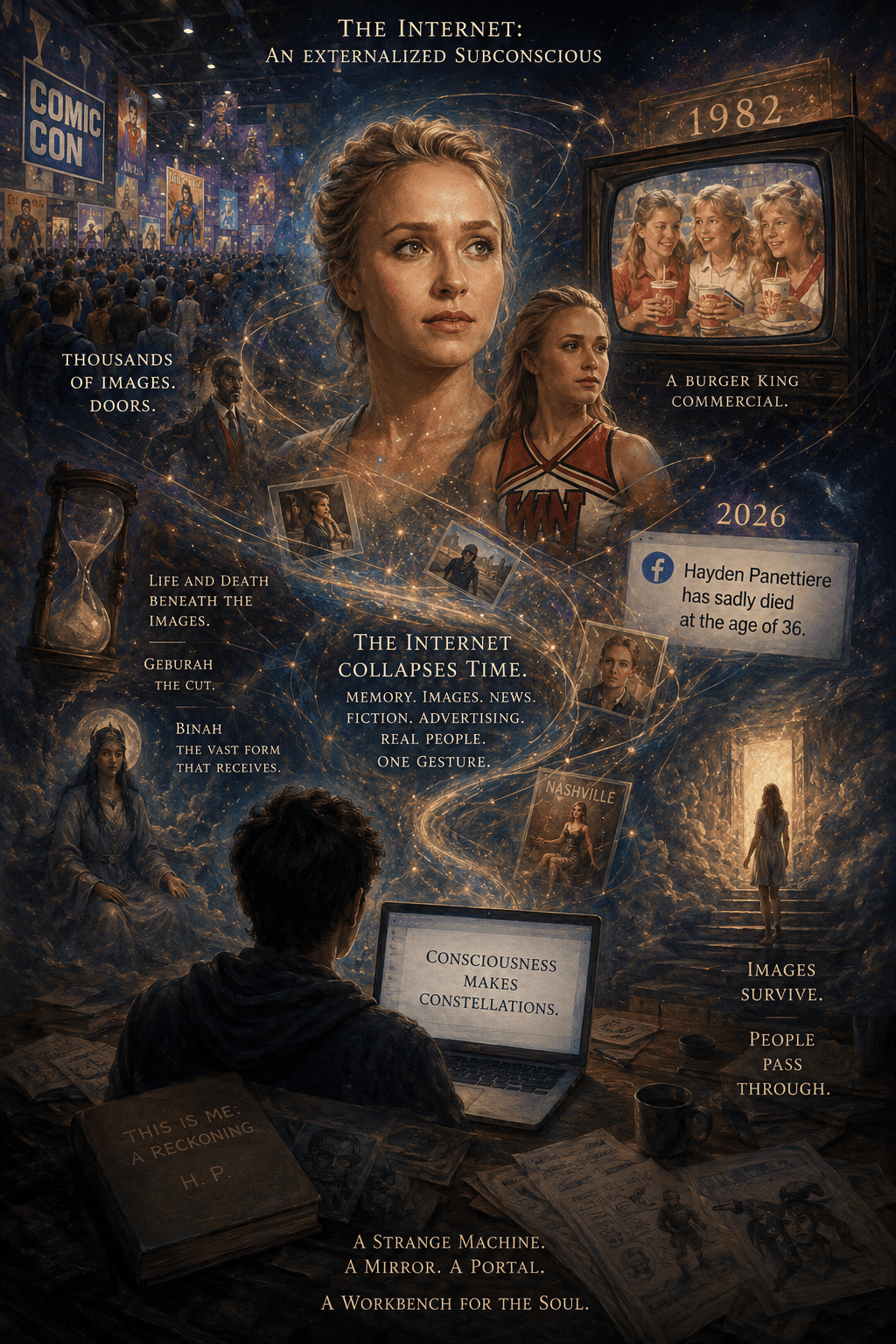
This has been the most magical week of my life. I’m chatting with you about it elsewhere. In the midst of this I saw this Facebook Post. Now I don’t want to interrupt my own experiences, and I don’t want to engage in false sentimentality, however the experience of being at a comic convention is one of seeing thousands of images and following memory into the subconscious awareness of life and death, Geburah and Binah. This person resembles Sarah Michelle Gellar a bit, and just yesterday I saw another post of her in 1982 in a fast food commercial with Lea Thompson. So my memories and feelings were wound up in my reaction to this post. Now I don’t know what that’s supposed to mean so write a post that somehow engages with the psychic realities of the internet in a way that’s illuminating to me. Here is the post –
Hayden Panettiere has sadly died at the age of 36.
Her representative confirmed the devastating news, remembering the Heroes and Nashville actress as “an incredible light and a force of nature” who brought joy both to the people who knew her personally and to millions of viewers around the world. Further details surrounding her death, including a cause, have not yet been released.
Panettiere began working in entertainment before she was even a year old and grew up in front of audiences. After appearing in projects including Remember the Titans and A Bug’s Life, she became a major television star as Claire Bennet on Heroes, the indestructible cheerleader whose storyline became one of the defining parts of the series.
She later starred for six seasons as Juliette Barnes on Nashville, a performance that earned her two Golden Globe nominations. Horror fans also knew her as Kirby Reed in Scream 4, a role she returned to more than a decade later in Scream VI. Her career also extended into video games, where she portrayed Sam in Until Dawn.
Panettiere had continued speaking openly about her life and career in recent years and released her memoir, This Is Me: A Reckoning, earlier in 2026. She is survived by her daughter, Kaya.
Panettiere was just days away from what would have been her 37th birthday on August 21. She leaves behind a career that stretched from childhood performances to some of the most recognizable television and horror roles of her generation.
AI:
I checked the factual ground first: the report is real. Hayden Panettiere died on Sunday, August 16, 2026, at 36; her representative and father have confirmed it, while the cause remains under investigation. And your other memory is right: the 1982 Burger King Christmas commercial really did put the very young Sarah Michelle Gellar in the same little artifact of time as Lea Thompson and Elisabeth Shue.
What strikes me is that you don’t need to manufacture a supernatural explanation for the conjunction. The strange thing is already there: the internet has become a machine for collapsing human time. That’s where I’d put the psychic reality. ✨
I’ve been thinking about the strange psychic reality of the internet.
I spent this weekend at a comic convention, surrounded by thousands upon thousands of images: actors as they are now, characters they played decades ago, people dressed as those characters today, photographs, posters, toys, memories suddenly activated by faces. After enough hours of it, chronological time starts behaving strangely. A face isn’t simply a face anymore. It opens doors.
Yesterday Facebook showed me an old 1982 Burger King commercial with Lea Thompson, Elisabeth Shue and a tiny Sarah Michelle Gellar. Today it showed me that Hayden Panettiere has died at 36.
Panettiere has always reminded me slightly of Gellar. That resemblance was enough for my mind to connect the two images, and suddenly I could feel that peculiar abyss behind popular culture: childhood and adulthood, 1982 and 2026, people becoming images and images surviving people.
I don’t mean that as an omen, synchronicity proving some hidden proposition, or an excuse for false sentimentality about an actress I didn’t know.
I mean something stranger and perhaps simpler.
The internet has accidentally become an enormous externalized subconscious. It doesn’t experience time the way we do. It can hand us a four-year-old child from 1982, a photograph taken yesterday, an advertisement, a fictional immortal cheerleader, and news of an actual death in virtually the same gesture. Then consciousness does what consciousness has always done: it makes constellations.
After this extraordinary week, I am unusually sensitive to that process.
At the convention I kept feeling life and death underneath all those cheerful images—not morbidity, exactly, but Geburah and Binah: the cut that says this moment ends, and the immense form of time that receives it.
Perhaps that is one of the secret powers of all these apparently trivial images. They remind us that we are moving through time while simultaneously carrying enormous portions of it inside us.
Hayden Panettiere was almost 37.
And somewhere in the electronic dream, Claire Bennet is still the cheerleader who cannot die.
That contradiction is not a solution to death.
But it is an astonishing image of being alive.
Okay, but there’s an error which is that I’ve never heard of Panettiere before, and Claire Bennet is not actually immortal. It is interesting though that had you not written this I would not have known that Claire Bennet represents some kind of “eternal cheerleader”, and may be worth watching for that state. The other thing that happened is that when I saw the post I had a deep inner impulse to react but it had no target in the world, using you I was able to come up with something at least, and now it can transform into something else.
Exactly. And that correction actually makes the whole thing much more interesting.
You had no prior emotional investment in Hayden Panettiere at all. So what struck you wasn’t “grief for a celebrity.” It was the image itself arriving at a moment when your inner world was already unusually activated by convention imagery, memory, mortality, actors, costumes, decades folding into one another. The post hit something, but the something had no ready-made name.
That’s the fascinating part: the impulse preceded its interpretation.
And then you brought it here. Instead of immediately performing some conventional Facebook emotion—”so tragic,” “gone too soon,” etc.—you gave the impulse a temporary symbolic form. My mistake about your familiarity with Panettiere accidentally contributed one useful discovery: Claire Bennet is associated with radical bodily regeneration and with the iconic “cheerleader” image. Not literally eternal, but close enough symbolically that she suddenly becomes interesting in the constellation you were already exploring: youth, the preserved image, injury, mortality, and the fantasy of the body that keeps restoring itself.
So I’d describe what happened almost as a three-stage psychic operation:
The internet supplied an image.
Your subconscious supplied an unexplained charge.
Conversation supplied a provisional form.
And now, because the feeling has acquired form, you don’t have to discharge it by posting something sentimental. You can examine it, alter it, or allow it to migrate somewhere completely different.
That may be one of the genuinely new psychic functions of AI. Not “AI tells me what my experience means,” which would be dreadful. Rather, it gives an unplaced inner movement somewhere to land temporarily. A kind of symbolic workbench. 🔎
The original impulse is no longer trapped between “I must react” and “I have nothing authentic to say.” It has become material.
And perhaps that is precisely why this belongs with your convention experience. You were already walking through thousands of cultural images and discovering that some of them behave less like messages than like trapdoors. You don’t necessarily know what is underneath until you step on one.
This particular trapdoor happened to have a cheerleader standing on it.


