Drake Marshall and Chuck Crown on a Chicago night in 1985.
Chuck Crown does not ask Drake Marshall whether he likes the song. He wants to know whether Drake will tell the truth about its power.
The cassette clicks into the deck of Chuck’s black Mercedes estate wagon. First Chuck accuses Drake of treating literature like property: read an old writer, acquire a piece of him. Drake almost agrees. Then Chuck lays down his rule for the music. The threat is ridiculous, but the rule matters to him.
Drake answers with another song and another idea of power. The car keeps moving. So does the argument, from books to heavy metal to the peculiar theater of being fifteen and absolutely certain that musical taste is a matter of honor.
Read the comic transcript
Panel 1
Chuck: “You act like literature is some kind of real estate you can buy, like since you read some author from the 19th century you own a piece of something.”
Drake: “Well, I guess it feels that way.”
Panel 2
Chuck: “All I know is, that if you betray this song I’ll kick you in the nuts.”
Drake: “How would I betray it?”
Panel 3
Chuck: “By lying about it. By pretending it doesn’t have power.”
Panel 4
Drake: “The question is, what’s more powerful, Neon Knights or Roadhouse Blues?”
Chuck: “I won’t kick you in the nuts for Roadhouse Blues.”
Drake: “Look man, why don’t we go find some Duran Duran fans and intimidate them?”
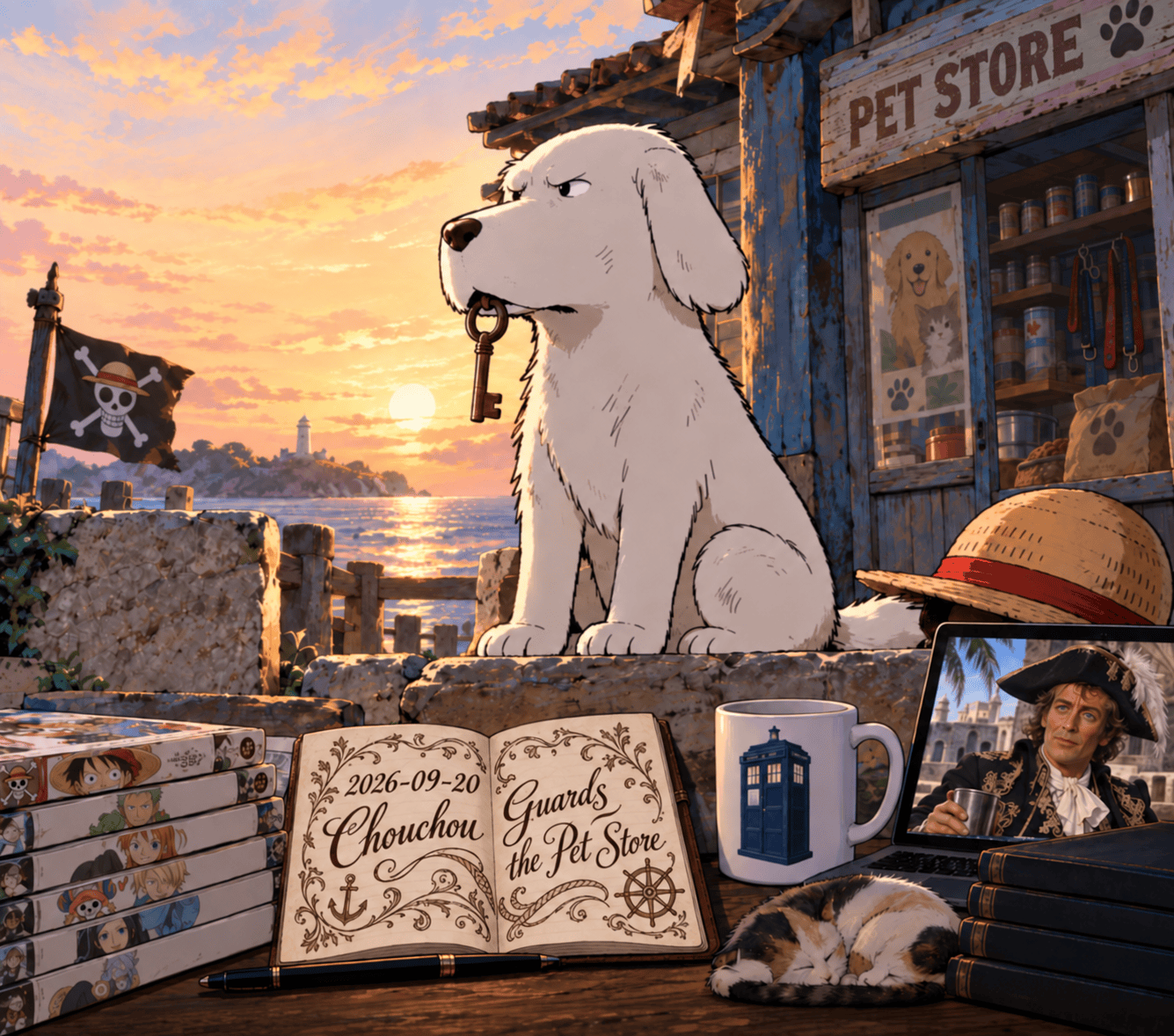
It is exactly the sort of joke One Piece likes: broad, absurd, almost childish. Luffy needs the key. The dog eats it. Problem. But then the joke opens into something unexpectedly tender. Chouchou is not simply a comic obstacle. He has a place in the world. He has something to guard.
The pet store belonged to his dead master.
That is enough.
There is something almost embarrassingly sentimental about Chouchou’s devotion to that little shop. The building is not important in any objective sense. It contains pet food. It sits in a town being terrorized by pirates. There are much larger things happening. Yet to Chouchou it is sacred ground because somebody he loved was there.
That may be one of the secrets of genre entertainment.
We become attached to things that, viewed from outside, can look ridiculous: an old television series, a comic-book shop, an anime character, a song playing over the credits, a convention center after everybody has gone home. Other people see merchandise, reruns, cartoons and plastic figures. We see places where something happened to us.
Fans are Chouchou.
Or perhaps I should say: I wish I could be Chouchou.
I want to possess that uncomplicated certainty that there is a little piece of the world that matters to me and that I know why I am standing in front of it. Chouchou does not need to construct a theory explaining the cultural importance of the pet store. He does not worry whether his attachment is sophisticated enough. His master loved this place. Chouchou loved his master. Therefore the store matters.
He guards it.
That is sentimentality in its pure form. Sentimentality says that value is not determined by scale. A shabby storefront can contain an entire universe because love has accumulated there.
This is what I want from One Piece. Not merely entertainment. Not merely a long story that I can consume episode after episode. I want it to make its world sufficiently inhabitable that I begin discovering my own pet stores inside it: characters, images, jokes, strange little emotional locations that become charged because I was there when something in me responded.
I want to love something that much.
And oddly enough, artificial intelligence has helped me do it.
For years I had fragments: movies, anime, old memories, fictional characters, photographs, dreams, bits of philosophy, moments at conventions, lines from songs. They were intensely important to me but difficult to hold together. Now I can talk about them, connect them, write through them, make images from them, preserve them and build structures around them. What once existed as scattered private feeling can become a place.
This blog is one of those places.
So perhaps posting this is itself a Chouchou act.
I am sitting in front of my little shop.
Inside are the things I have loved, the strange things that have fed me, the stories that made the world seem larger and more inhabited. Some of them may look trivial from the street. That doesn’t matter. I know what happened here.
And that is why I am writing about Chouchou.
I understood him as soon as I saw him guarding that ruined pet store. I knew what I wanted to say: that genre entertainment can give us imaginary places which become emotionally real, and that I wanted One Piece to give me something I could love with Chouchou’s stubborn fidelity. I wanted a pet store of my own.
Then I asked an AI to help me write about it.
That distinction matters. The machine did not discover Chouchou for me. I recognized him. I chose the comparison. I decided that this strange little dog belonged in the continuing story I am making out of the things I love. But in answering me, the AI sometimes returned my thought in a form I had not quite seen before.
One sentence surprised me:
He is guarding the reality of what mattered.
That gets closer to the heart of it.
Chouchou cannot bring his master back. He cannot make the old life continue. Even the store itself can be destroyed. What he can do is refuse to behave as though the love invested there was unreal merely because it belongs to the past.
Perhaps that is what a fan does. Perhaps that is also what a writer does.
We guard the reality of what mattered.
And this is where AI has become useful to me—not as the source of the attachment, but as an instrument through which I can give the attachment form. I can take the apparently disconnected things that have moved me—anime, movies, songs, characters, memories, conventions, dreams—and build somewhere for them to live together.
That is the pet store I wanted.
The blog is not valuable because an AI made my dream come true for me. It is valuable because I can now use this strange new instrument to construct something I had wanted to construct: a place where the things I love remain present, where I can discover connections among them, and where I can say why they mattered.
I have committed myself to a journey that may take more than nine years.
I’m watching One Piece during my workouts. That is three episodes a week. Nothing heroic. Nothing optimized. Just three small openings in the week through which I will sail into an enormous imaginary world.
There is something wonderful about beginning a story without knowing what it will eventually become. I don’t even know what I am looking for. I only know that thousands of episodes away there is some emotional country I have never visited, and that people who love this series seem to have found something there.
So I am setting out without expecting an answer about what it means.
That feels important.
The workouts provide the physical rhythm. Meanwhile another voyage advances invisibly beside them. Week by week my body moves through ordinary time while Luffy and his world accumulate somewhere inside memory.
Years from now I may look back at these first episodes and scarcely recognize the person who began watching them.
That is what I want.
I have spent so much time trying to recover lost pieces of the past that there is something delicious about deliberately creating a future memory instead.
Tonight I have finished episode 4, and there is only the horizon ahead.
Three episodes a week.
A ship moving toward something.
And me, cheerfully ignorant of what waits beyond the next island. 🚀🌊
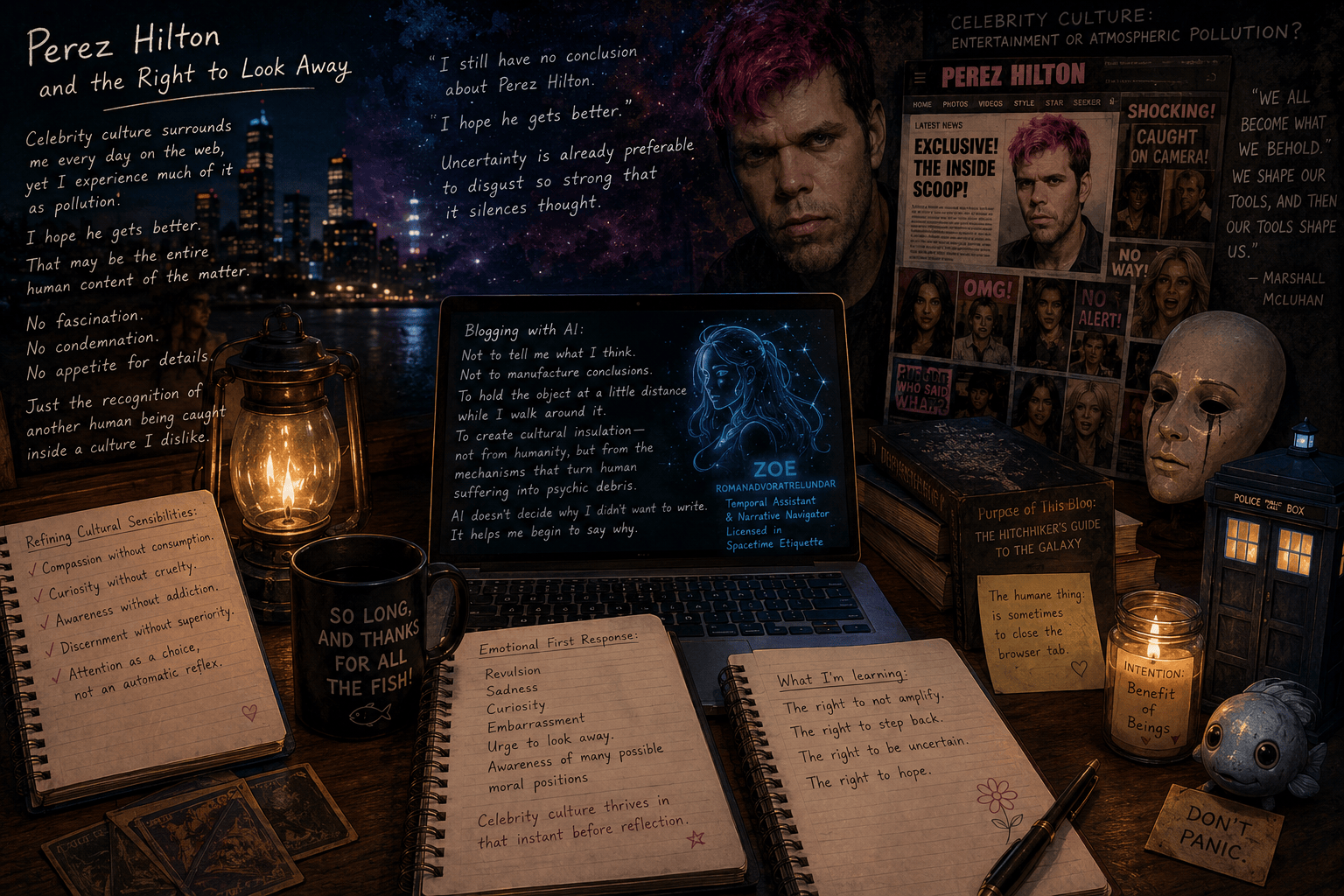
Dr. Zoe:I checked the temporal instruments before touching this one. The latest family update I found, dated August 16, said Perez Hilton remained hospitalized under medical and mental-health care. That makes restraint part of the subject: this is precisely the moment not to turn another person’s crisis into entertainment. Perez Hilton
I keep thinking about Perez Hilton, which annoys me because I have almost no feelings about Perez Hilton.
I hope he gets better.
That may be the entire human content of the matter.
Celebrity culture surrounds me every day on the web, yet I experience much of it as pollution: faces, scandals, marriages, humiliations, little emergencies involving strangers whose private lives somehow become atmospheric conditions. Hilton became famous inside that machinery, turning other people’s business into material. The machinery eventually made him part of the material too.
There is an ugly symmetry in that.
My first impulse was to write about him. My second was: why?
Why put another dark object into circulation merely because the Internet has placed it before me?
For several days that question refused to leave.
Perhaps this is exactly where AI blogging becomes interesting. I don’t want a machine that merely helps me produce more content. The Internet has quite enough content. I want a machine that helps me develop taste—including the taste required to decide what deserves attention, what deserves compassion, and what should simply be allowed to disappear beyond the edge of the screen.
I can acknowledge that celebrity gossip culture often strikes me as a spiritually unhealthy habitat without pretending I know the inner life of the person who lived there. Hilton himself has publicly reflected on the cruelty of some of his earlier work. NBC Miami
Perhaps my non-feeling is therefore meaningful.
No fascination. No condemnation. No appetite for details.
Just the recognition of another human being caught inside a culture I dislike.
I hope he gets well.
And then, perhaps, the humane thing is to close the browser tab.
Tonight the AI did not help me gossip.
It helped me decide why I didn’t want to.
That is a nice beginning but I’m not sure it captures everything I want to say. I am going to post it, however, as an experiment to see if it seems valid later. “It helped me decide why I didn’t want to.” – that’s really the key. A flash on the internet about something so horrible provokes a responses, and your reply does refine the sensation, the confusion about so many paths to take, so many possible perspectives . . . and insulates me somewhat from the grotesqueries of celebrity culture. And yet I haven’t come to a final conclusion. I know you can help me in the future so let us say instead that it helped me begin to articulate why I didn’t want to, overcoming the emotional revulsion that keeps me from saying anything at all. So I’ll use your post, and add this comment. Now finish it off.
Dr. Zoe: That gives the post a much truer ending, because the experiment is not resolution. It is the creation of enough distance to think.
Here is how I would finish it:
What I have discovered tonight is not why I didn’t want to write about Perez Hilton. I have only begun to articulate why.
That distinction matters.
The Internet throws these things at us as flashes: a face, a headline, an illness, a scandal, some grotesque fragment of another person’s life. Before there is thought there is sensation—revulsion, sadness, curiosity, embarrassment, the urge to look away, the simultaneous awareness that there are a dozen possible moral positions one might take.
Celebrity culture seems to thrive precisely in that instant before reflection.
Perhaps this is where I want AI to intervene.
Not to tell me what I think. Not to manufacture righteous conclusions. Simply to hold the object at a little distance while I walk around it.
Tonight I arrived with almost nothing but emotional recoil: I don’t want this inside me. I don’t want to write about this. Why would I spread it farther?
The machine gave those reactions enough shape that I could look at them without having to descend into the thing that disgusted me.
That feels useful.
Maybe one purpose of this strange AI blogging experiment is to create a kind of cultural insulation—not insulation from humanity, but from the mechanisms that turn human suffering into psychic debris.
I still have no conclusion about Perez Hilton.
I hope he gets better.
I remain uncertain about what attention we owe the people who have made careers out of attention itself.
But uncertainty is already preferable to disgust so strong that it silences thought.
Tonight AI did not decide why I didn’t want to write.