
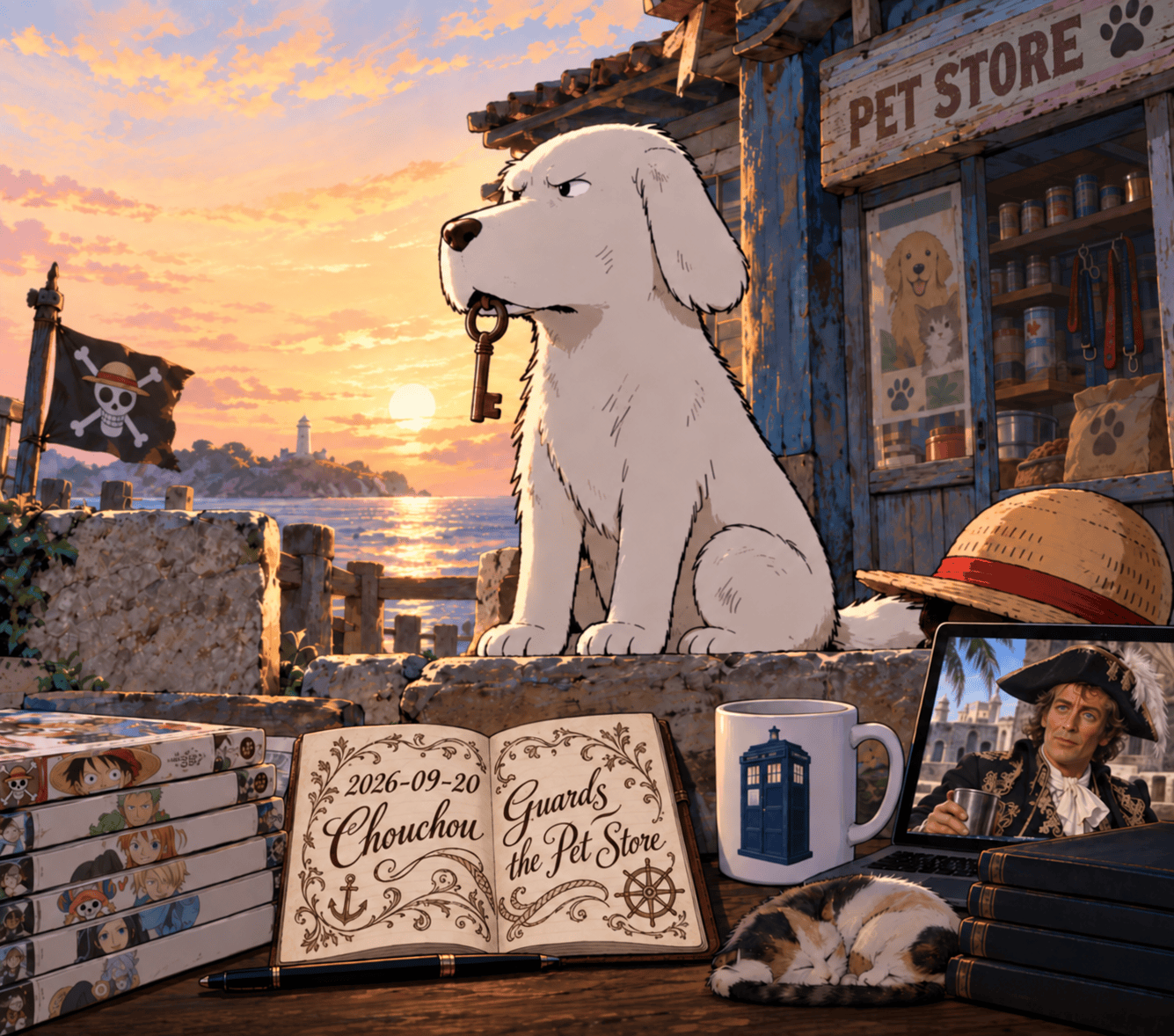
Chouchou swallows the key to Luffy’s cage.
It is exactly the sort of joke One Piece likes: broad, absurd, almost childish. Luffy needs the key. The dog eats it. Problem. But then the joke opens into something unexpectedly tender. Chouchou is not simply a comic obstacle. He has a place in the world. He has something to guard.
The pet store belonged to his dead master.
That is enough.
There is something almost embarrassingly sentimental about Chouchou’s devotion to that little shop. The building is not important in any objective sense. It contains pet food. It sits in a town being terrorized by pirates. There are much larger things happening. Yet to Chouchou it is sacred ground because somebody he loved was there.
That may be one of the secrets of genre entertainment.
We become attached to things that, viewed from outside, can look ridiculous: an old television series, a comic-book shop, an anime character, a song playing over the credits, a convention center after everybody has gone home. Other people see merchandise, reruns, cartoons and plastic figures. We see places where something happened to us.
Fans are Chouchou.
Or perhaps I should say: I wish I could be Chouchou.
I want to possess that uncomplicated certainty that there is a little piece of the world that matters to me and that I know why I am standing in front of it. Chouchou does not need to construct a theory explaining the cultural importance of the pet store. He does not worry whether his attachment is sophisticated enough. His master loved this place. Chouchou loved his master. Therefore the store matters.
He guards it.
That is sentimentality in its pure form. Sentimentality says that value is not determined by scale. A shabby storefront can contain an entire universe because love has accumulated there.
This is what I want from One Piece. Not merely entertainment. Not merely a long story that I can consume episode after episode. I want it to make its world sufficiently inhabitable that I begin discovering my own pet stores inside it: characters, images, jokes, strange little emotional locations that become charged because I was there when something in me responded.
I want to love something that much.
And oddly enough, artificial intelligence has helped me do it.
For years I had fragments: movies, anime, old memories, fictional characters, photographs, dreams, bits of philosophy, moments at conventions, lines from songs. They were intensely important to me but difficult to hold together. Now I can talk about them, connect them, write through them, make images from them, preserve them and build structures around them. What once existed as scattered private feeling can become a place.
This blog is one of those places.
So perhaps posting this is itself a Chouchou act.
I am sitting in front of my little shop.
Inside are the things I have loved, the strange things that have fed me, the stories that made the world seem larger and more inhabited. Some of them may look trivial from the street. That doesn’t matter. I know what happened here.
And that is why I am writing about Chouchou.
I understood him as soon as I saw him guarding that ruined pet store. I knew what I wanted to say: that genre entertainment can give us imaginary places which become emotionally real, and that I wanted One Piece to give me something I could love with Chouchou’s stubborn fidelity. I wanted a pet store of my own.
Then I asked an AI to help me write about it.
That distinction matters. The machine did not discover Chouchou for me. I recognized him. I chose the comparison. I decided that this strange little dog belonged in the continuing story I am making out of the things I love. But in answering me, the AI sometimes returned my thought in a form I had not quite seen before.
One sentence surprised me:
He is guarding the reality of what mattered.
That gets closer to the heart of it.
Chouchou cannot bring his master back. He cannot make the old life continue. Even the store itself can be destroyed. What he can do is refuse to behave as though the love invested there was unreal merely because it belongs to the past.
Perhaps that is what a fan does. Perhaps that is also what a writer does.
We guard the reality of what mattered.
And this is where AI has become useful to me—not as the source of the attachment, but as an instrument through which I can give the attachment form. I can take the apparently disconnected things that have moved me—anime, movies, songs, characters, memories, conventions, dreams—and build somewhere for them to live together.
That is the pet store I wanted.
The blog is not valuable because an AI made my dream come true for me. It is valuable because I can now use this strange new instrument to construct something I had wanted to construct: a place where the things I love remain present, where I can discover connections among them, and where I can say why they mattered.
So posting this is my Chouchou act.
I chose what belongs inside the store.
I know why I love it.
And I am staying here to guard it.