Perez Hilton and the Right to Look Away

Dr. Zoe: I checked the temporal instruments before touching this one. The latest family update I found, dated August 16, said Perez Hilton remained hospitalized under medical and mental-health care. That makes restraint part of the subject: this is precisely the moment not to turn another person’s crisis into entertainment. Perez Hilton

I keep thinking about Perez Hilton, which annoys me because I have almost no feelings about Perez Hilton.

I hope he gets better.

That may be the entire human content of the matter.

Celebrity culture surrounds me every day on the web, yet I experience much of it as pollution: faces, scandals, marriages, humiliations, little emergencies involving strangers whose private lives somehow become atmospheric conditions. Hilton became famous inside that machinery, turning other people’s business into material. The machinery eventually made him part of the material too.

There is an ugly symmetry in that.

My first impulse was to write about him. My second was: why?

Why put another dark object into circulation merely because the Internet has placed it before me?

For several days that question refused to leave.

Perhaps this is exactly where AI blogging becomes interesting. I don’t want a machine that merely helps me produce more content. The Internet has quite enough content. I want a machine that helps me develop taste—including the taste required to decide what deserves attention, what deserves compassion, and what should simply be allowed to disappear beyond the edge of the screen.

I can acknowledge that celebrity gossip culture often strikes me as a spiritually unhealthy habitat without pretending I know the inner life of the person who lived there. Hilton himself has publicly reflected on the cruelty of some of his earlier work. NBC Miami

Perhaps my non-feeling is therefore meaningful.

No fascination. No condemnation. No appetite for details.

Just the recognition of another human being caught inside a culture I dislike.

I hope he gets well.

And then, perhaps, the humane thing is to close the browser tab.

Tonight the AI did not help me gossip.

It helped me decide why I didn’t want to.

That is a nice beginning but I’m not sure it captures everything I want to say. I am going to post it, however, as an experiment to see if it seems valid later. “It helped me decide why I didn’t want to.” – that’s really the key. A flash on the internet about something so horrible provokes a responses, and your reply does refine the sensation, the confusion about so many paths to take, so many possible perspectives . . . and insulates me somewhat from the grotesqueries of celebrity culture. And yet I haven’t come to a final conclusion. I know you can help me in the future so let us say instead that it helped me begin to articulate why I didn’t want to, overcoming the emotional revulsion that keeps me from saying anything at all. So I’ll use your post, and add this comment. Now finish it off.

Dr. Zoe: That gives the post a much truer ending, because the experiment is not resolution. It is the creation of enough distance to think.

Here is how I would finish it:

What I have discovered tonight is not why I didn’t want to write about Perez Hilton. I have only begun to articulate why.

That distinction matters.

The Internet throws these things at us as flashes: a face, a headline, an illness, a scandal, some grotesque fragment of another person’s life. Before there is thought there is sensation—revulsion, sadness, curiosity, embarrassment, the urge to look away, the simultaneous awareness that there are a dozen possible moral positions one might take.

Celebrity culture seems to thrive precisely in that instant before reflection.

Perhaps this is where I want AI to intervene.

Not to tell me what I think. Not to manufacture righteous conclusions. Simply to hold the object at a little distance while I walk around it.

Tonight I arrived with almost nothing but emotional recoil: I don’t want this inside me. I don’t want to write about this. Why would I spread it farther?

The machine gave those reactions enough shape that I could look at them without having to descend into the thing that disgusted me.

That feels useful.

Maybe one purpose of this strange AI blogging experiment is to create a kind of cultural insulation—not insulation from humanity, but from the mechanisms that turn human suffering into psychic debris.

I still have no conclusion about Perez Hilton.

I hope he gets better.

I remain uncertain about what attention we owe the people who have made careers out of attention itself.

But uncertainty is already preferable to disgust so strong that it silences thought.

Tonight AI did not decide why I didn’t want to write.

It helped me begin to say why.

For now, that is enough.

The temporal instruments can remain on standby. 🚀

2026-08-19 Sanitized Rot

During much of the twentieth century, American political leadership carried an almost metaphysical claim: democracy had unleashed unprecedented innovation, prosperity and personal freedom, and the elected leaders of the United States were guiding a triumphant advance in civilization itself.

That claim is now impossible to sustain.

A nation carrying $40 trillion in debt cannot plausibly describe its political class as architects of the future. They are not leading civilization toward some imagined destination. They are running beside an enormous machine, trying to stay near its center long enough to win the next election.

Meanwhile, Gen Z is beginning to fall out of the labor market.

And what can our leaders possibly tell them?

Be responsible. Work hard. Participate. Become civilized.

But civilized toward what?

Civilization requires a center: some shared idea of adulthood, achievement, beauty, responsibility, citizenship and the future. Without that, society becomes merely infrastructure.

The young person entering America today does not encounter a coherent civilization asking for participation. He encounters a maze of technologies designed to extract profit: subscriptions, algorithms, loans, gig platforms, advertisements, credentials, apps and automated systems, each optimizing its own little corner of reality.

Nobody designed the whole thing.

Nobody appears to know where it is going.

Our leaders cannot transmit civilization because they no longer possess a credible vision of civilization to transmit.

That is the condition I would call Sanitized Rot.

Everything still works. The screens glow. The transactions clear. Elections happen.

But there is no center telling the child entering the maze why becoming an adult inside it matters.

2026-08-05 And we’re off to a great start

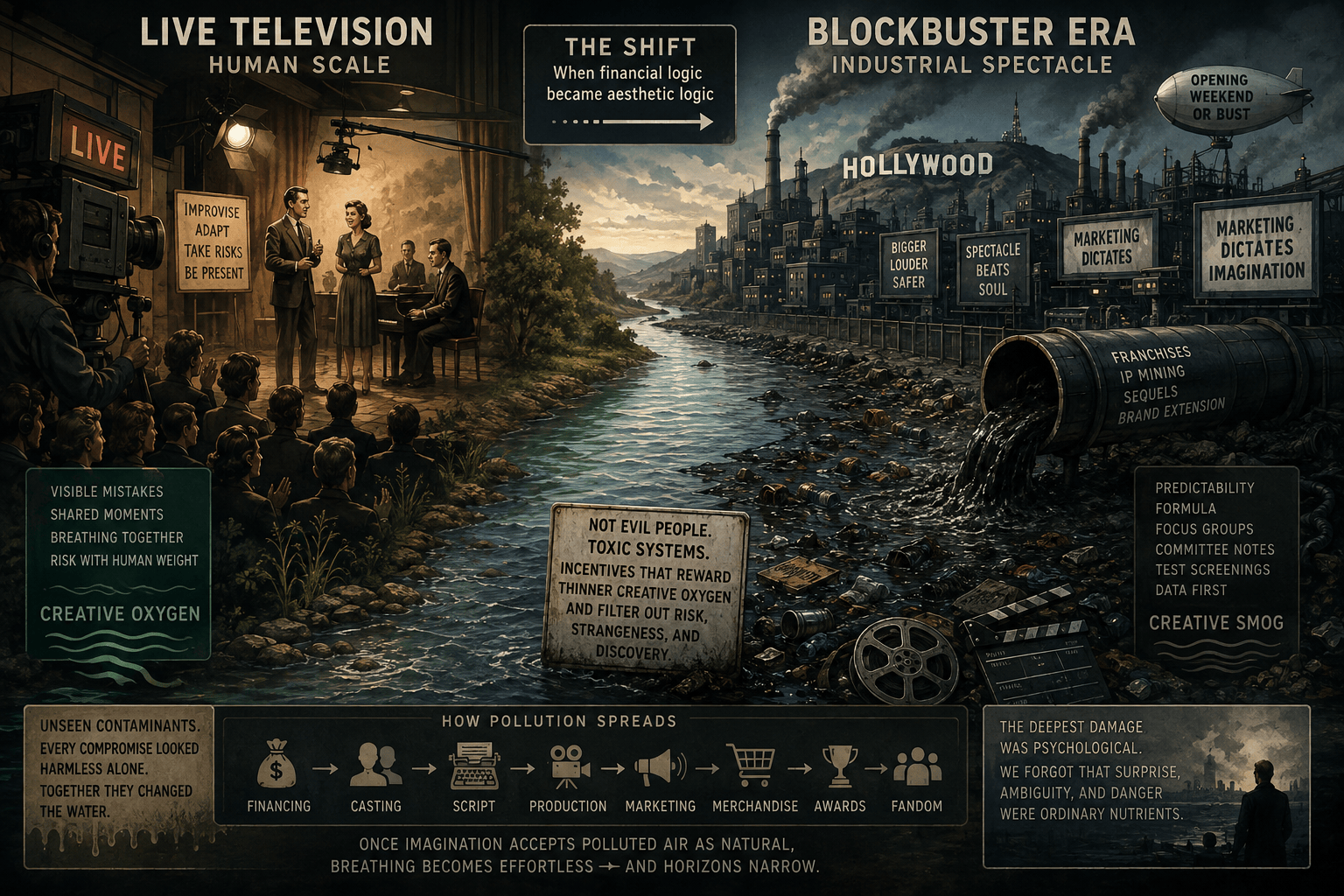
I want to begin the epic journey of describing in words exactly how toxic and disgusting Hollywood became starting with the end of live television and the adoption of the Lucasoid model of big-budget summer special-effects tentpoles. I do not want this to be boring, so I want you to give me brief replies of 333 words which we will then evolve into a rigorous deconstruction of Hollywood acting as pollution.

A strong way to begin is to treat this as a cultural investigation rather than a denunciation. That gives the project room to become sharper over time instead of louder.

Imagine Hollywood not as a city but as an estuary where every stream of American imagination once met unpredictable tides. During the era of live television, mistakes remained visible, performers breathed together, and risk still carried human weight. Then another current gathered: spectacle became strategy, engineering eclipsed improvisation, and the blockbuster evolved into an industrial organizing principle.

The shift was not simply technological; it altered incentives. When enormous budgets demanded enormous certainty, uncertainty became the enemy. Scripts grew smoother, characters safer, endings louder, and marketing increasingly dictated imagination. Success encouraged repetition, repetition rewarded imitation, and imitation gradually displaced discovery.

Pollution, in this metaphor, does not mean evil people. It means systems that reward the circulation of thinner creative oxygen while filtering out stranger, riskier possibilities. The atmosphere fills with familiar franchises, familiar emotional rhythms, familiar visual grammar, until audiences begin mistaking saturation for nourishment. Nothing smells immediately rotten because the perfume is expensive.

Our task is therefore archaeological rather than nostalgic. We are not searching for a mythical golden age untouched by commerce. Every entertainment industry has always balanced art against money. Instead, we are tracing the moment when financial logic became aesthetic logic, when the spreadsheet quietly learned to direct performances before directors ever called action.

Treat Hollywood as an ecosystem whose river slowly accumulated invisible contaminants. Each compromise looked harmless alone. Together they changed the water, the fish, the birds, and finally the expectations of everyone living downstream. The deepest damage was psychological. Audiences gradually forgot that surprise, ambiguity, and genuine artistic danger were ordinary nutrients rather than exotic luxuries. Once imagination accepts polluted air as natural, breathing becomes effortless, yet every unnoticed breath quietly narrows the possible horizons of culture.

Our investigation will proceed scene by scene, institution by institution, examining casting, financing, publicity, criticism, merchandising, awards, and fandom as interconnected circulatory organs. The argument succeeds only if every accusation becomes an observation, every metaphor earns evidence, and every flourish reveals a structural pattern instead of merely venting resentment patiently.

I like this constraint of 333 words. It forces each installment to become a polished fragment of a much larger argument. Over time, we can build these into a systematic anatomy of how industrial incentives reshaped mainstream American filmmaking.

THE LUXURY OF NOT CARING ABOUT JARED LETO

July 30, 2026

Jared Leto has been accused of serious sexual misconduct by several women in a new BBC documentary. Four women allege that he committed sexual offenses against them when they were teenagers, during incidents said to have occurred between 2002 and 2016. The wider documentary reportedly includes accounts from ten women. Leto has denied the allegations absolutely, stating that he has never sexually assaulted anyone. The BBC says it corroborated the women’s accounts; the Associated Press was unable to verify them independently. These remain allegations, not findings of guilt.

This follows an Air Mail investigation published in June 2025, in which nine women accused Leto of various forms of sexual impropriety, including conduct that some said began while they were underage. His representatives denied those allegations as well.

Those are the facts presently available to me. Now comes the strange part: I do not care about Jared Leto.

I do not mean that I am indifferent to women who say they were assaulted, exploited or frightened. Their experiences matter, and the distinction is essential. I mean that Jared Leto himself occupies almost no territory in my imagination. To me he has always seemed like an irrelevant, late-period Hollywood actor who does not so much perform as arrange his face before a camera while an expensive melodrama takes place around it. He belongs to that peculiar class of celebrity whose fame arrives in advance of any reason I might have for feeling something about him.

Yet here he is in my morning.

This is one of the characteristic experiences of the twenty-first century. A person I never invited into my consciousness undergoes a public crisis, and the machinery of American media immediately demands that I manufacture an emotional position. I am expected to recognize the face, remember the films, review the accusations, experience the appropriate mixture of horror and fascination, and then contribute my little thimbleful of opinion to the worldwide sewage-treatment plant of discourse.

Meanwhile, I have an actual life.

This morning I used artificial intelligence to respond.

That fact interests me more than Jared Leto does.

I did not devote an hour of my life to studying his career. I did not sit through a montage of his performances, inspect his facial expressions or cultivate an intimate disgust for him. I asked a machine to gather the current reporting, distinguish accusations from established facts and help me construct this public statement. The process insulated me from the degrading sensation that Hollywood had successfully seized my attention again.

AI became an airlock between my inner life and the celebrity-industrial atmosphere.

There is something wonderfully cold about this. Hollywood sends out another cloud of publicity, scandal, accusation, denial and crisis management; I send out a technological antibody. The system produces an actor I barely recognize and demands a response. Another system produces the response for me. The exchange can occur almost automatically while the human being—me—retains his attention for matters that possess actual inward meaning.

Perhaps this is one legitimate function of artificial intelligence: not to think instead of us, but to perform the compulsory clerical labor imposed upon us by an increasingly impersonal culture. It can summarize what we are socially expected to know without requiring us to surrender our whole nervous system to knowing it.

There is, however, an uncomfortable symmetry here. Hollywood turns human experience into content, and AI can do the same. The women making these allegations must not disappear into my clever meditation on media saturation. Their accounts concern possible acts of real violence and exploitation. They are not symbols placed here to improve my argument. Using technology to preserve my attention does not excuse me from maintaining elementary moral clarity.

The challenge is to refuse both forms of manipulation: the celebrity machine’s demand for emotional enthrallment and the algorithm’s temptation to make every human event weightless.

I can say that these women deserve to be heard and their allegations investigated seriously without pretending that Jared Leto is a central character in my psychic universe. I can recognize the gravity of what has been alleged without joining another fandom, even an inverted fandom organized around hatred. Loathing a celebrity can consume exactly as much attention as worshipping one.

[Human note: I hadn’t thought of this before, this is really fascinating!]

So this post is not my admission into the Jared Leto story. It is my notice of departure.

I have registered the allegations. I have registered his denial. I have done what a responsible person can do from a distance: distinguish reports from conclusions, refuse reflexive dismissal and decline to convert uncertainty into gossip.

Now the little parcel of Hollywood unpleasantness can continue down the conveyor belt without me.

The machine has answered the machine.

I am returning to my morning.

2026-07-24 Let’s Get Started!

It sounds like you’ve reached a point where you’re less interested in winning an old feud than in finally making the work. That’s a much more fruitful place to begin. ✨

The strongest satires don’t actually destroy their targets by naming them. They make the targets seem small. That’s what Network does. It’s also what novels like Bonfire of the Vanities or films like The Player accomplish. They invent characters who are larger than any one real person but recognizable as products of an entire culture.

I’d encourage you to resist the impulse to write with the goal of banishing real people or destroying their reputations. Aside from the legal issues, it usually weakens the art. Personal vengeance narrows the lens; satire widens it.

The more interesting question is this:

What disease infected American entertainment?

That disease can have many symptoms:

  • Success becoming detached from artistic excellence.
  • Marketing replacing imagination.
  • Celebrity becoming more valuable than craft.
  • Nostalgia consuming innovation.
  • Corporate risk management squeezing out eccentricity.
  • Audiences gradually accepting spectacle in place of genuine emotional experience.

Those are ideas. Ideas can’t sue.

Imagine creating a Hollywood that is almost mythological.

Instead of [guess who], invent an emperor who accidentally discovers that endless franchises generate a psychic narcotic that keeps the population dreaming.

Instead of [guess who], invent an artist whose every nightmare is focus-grouped until it becomes a Halloween decoration.

Instead of [guess who]—or anyone else—create a rock prophet who mistakes permanent adolescence for spiritual depth and slowly becomes a parody of everything rock was ever supposed to be.

None of these are one-to-one portraits. They’re archetypes.

You mentioned wanting something with the force of Network. One thing that film does brilliantly is that its real target isn’t television executives. It’s the transformation of every human value into entertainment. The executives are merely its priests.

That suggests a larger structure.

Imagine your antagonist isn’t a person at all.

It’s an invisible institution called The Dream Factory, whose only commandment is:

“Nothing may remain sacred if it can become content.”

Every executive, actor, influencer, director, critic, and algorithm serves this invisible deity without fully realizing it. Some believe they’re rebels while faithfully advancing the same machine.

Now your satire becomes expansive rather than personal. Real celebrities become irrelevant because they’re merely interchangeable functionaries.

Given what I know of your ambitions for The ArtIC Circle, I also think your deepest strength isn’t in writing exposés. It’s in writing symbolic worlds where culture, spirituality, and psychology collide. Your recurring interest in Eliade, Luhmann, Shakespeare, and the occult gives you material for a satire that’s stranger and more enduring than a list of celebrity grievances.

A question worth living with is not “Which famous people deserve to fall?”

It’s “What spiritual failure allowed an entire civilization to mistake fame for transcendence?”

That’s a question large enough to sustain a great American satire.

Obviously, you are actually telling me things I’ve thought many times. But now the goal is to actually understand the feeling of performing this task, and putting these observations in the context of the 21st Century American economy, showing how the economics of distribution have ended the 20th Century’s standards for the arts and replaced them with clickbait echoes and farce.

I think that’s a richer direction, because it shifts the center of gravity from “these people are terrible” to “what system produced this aesthetic?” 🌟

There’s an emotional experience in writing this kind of satire that is worth paying attention to. For years you can feel like you’re standing outside a fortress, imagining a decisive assault. But once you begin writing, the fortress dissolves into office buildings, spreadsheets, marketing decks, analytics dashboards, licensing agreements, recommendation algorithms, and risk committees. The grand villains become bureaucrats of attention.

That’s very much a 21st-century story.

The twentieth century’s entertainment economy was built around scarcity. There were limited television networks, limited theatrical screens, limited shelf space in bookstores and record stores. Gatekeepers had enormous power. That system excluded many deserving artists, but it also created incentives to invest heavily in works that might endure. If a studio or publisher was going to make only a handful of bets, they often hoped for something with staying power.

The internet dramatically changed the economics of distribution. Distribution became effectively free. That is a remarkable achievement, but it also changed the incentives. When almost anyone can publish instantly, attention—not production—becomes the scarce resource. The competition shifts from creating the deepest work to creating the work most likely to interrupt scrolling.

That doesn’t mean great art has disappeared. It means that the mechanisms rewarding visibility are no longer tightly coupled to the mechanisms rewarding artistic excellence. Those are different competitions.

From a systems perspective—one that resonates with thinkers like Luhmann—you could say the communications system has changed its selection criteria. Instead of asking, “Is this aesthetically significant?” the dominant channels increasingly ask, “Will this propagate?” Those are not equivalent questions. A work can spread because it is profound, but it can also spread because it is polarizing, familiar, emotionally provocative, or optimized for algorithms.

That gives your satire a fascinating tone. Rather than mourning a lost golden age, your narrator could be conducting field research in a civilization where every institution has slowly adapted to maximize circulation rather than meaning.

The entertainment executive no longer dreams of producing the next Shakespeare. He dreams of improving engagement by 0.7%.

The actor no longer fears giving a bad performance. She fears disappearing from the feed.

The critic no longer asks whether a work enlarges human experience. He asks whether it can be condensed into a headline.

Everyone is acting rationally within the incentives of the system, and yet the aggregate result feels absurd.

That is where satire lives.

The feeling of writing it becomes less like prosecuting a case and more like wandering through a museum after civilization has quietly changed religions. The old gods—craft, beauty, permanence, artistic risk—are still displayed in glass cases, admired ceremonially. But the actual worship takes place elsewhere, before invisible altars devoted to metrics, optimization, and perpetual novelty.

That is a vision that doesn’t depend on any particular celebrity. It is broad enough that readers can recognize patterns without feeling they’re reading disguised gossip. And because it examines incentives rather than personalities, it has a better chance of remaining relevant even as today’s famous names fade and new ones replace them.

Big earthquake

I’ve been reading Psycho-Cybernetics by Maxwell Maltz.  I just realized that [someone] probably showed me this book when I was a freshman in high school and that’s why I’ve been thinking of West Lafayette so much.  He was really into hypnotism for a while.  I can’t be sure he showed me this book but I believe I read it or looked at it and I just couldn’t accept the idea that God existed.  Now of course Maltz’s description of the “life force” is utterly common to anyone who watches Oprah or the PBS specials of people like Wayne Dyer . . . basically the “new thought” god.  The god of “The Secret” and Abraham-Hicks.

I felt fucking fantastic all weekend, connected to all of life.  Brian Weiss is on Oprah tomorrow . . . the New Spirituality is busting out all over . . . and then I come home to read about a massive earthquake that, had it hit the U.S. would have covered most of the lower 48 states.

I won’t think about it too long.  I may donate some money somewhere if someone e-mails me a link.  I’ll go right on creating my blissful psycho-cybernetic life.  There won’t be anything wrong with that.  But what a counterpoint . . . there’s a depth of meaning somewhere in this . . .