
I want to begin the epic journey of describing in words exactly how toxic and disgusting Hollywood became starting with the end of live television and the adoption of the Lucasoid model of big-budget summer special-effects tentpoles. I do not want this to be boring, so I want you to give me brief replies of 333 words which we will then evolve into a rigorous deconstruction of Hollywood acting as pollution.
A strong way to begin is to treat this as a cultural investigation rather than a denunciation. That gives the project room to become sharper over time instead of louder.
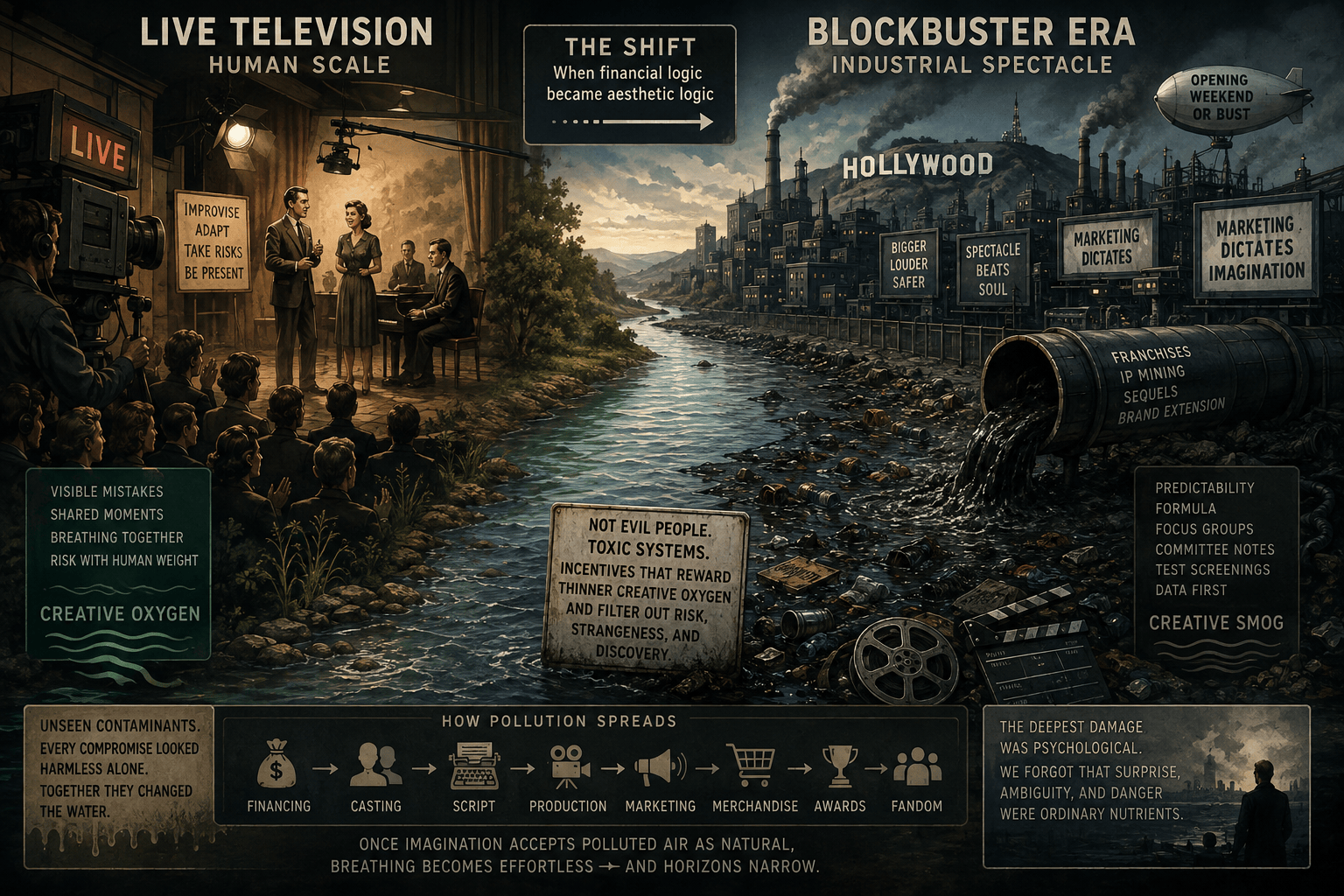
Imagine Hollywood not as a city but as an estuary where every stream of American imagination once met unpredictable tides. During the era of live television, mistakes remained visible, performers breathed together, and risk still carried human weight. Then another current gathered: spectacle became strategy, engineering eclipsed improvisation, and the blockbuster evolved into an industrial organizing principle.
The shift was not simply technological; it altered incentives. When enormous budgets demanded enormous certainty, uncertainty became the enemy. Scripts grew smoother, characters safer, endings louder, and marketing increasingly dictated imagination. Success encouraged repetition, repetition rewarded imitation, and imitation gradually displaced discovery.
Pollution, in this metaphor, does not mean evil people. It means systems that reward the circulation of thinner creative oxygen while filtering out stranger, riskier possibilities. The atmosphere fills with familiar franchises, familiar emotional rhythms, familiar visual grammar, until audiences begin mistaking saturation for nourishment. Nothing smells immediately rotten because the perfume is expensive.
Our task is therefore archaeological rather than nostalgic. We are not searching for a mythical golden age untouched by commerce. Every entertainment industry has always balanced art against money. Instead, we are tracing the moment when financial logic became aesthetic logic, when the spreadsheet quietly learned to direct performances before directors ever called action.
Treat Hollywood as an ecosystem whose river slowly accumulated invisible contaminants. Each compromise looked harmless alone. Together they changed the water, the fish, the birds, and finally the expectations of everyone living downstream. The deepest damage was psychological. Audiences gradually forgot that surprise, ambiguity, and genuine artistic danger were ordinary nutrients rather than exotic luxuries. Once imagination accepts polluted air as natural, breathing becomes effortless, yet every unnoticed breath quietly narrows the possible horizons of culture.
Our investigation will proceed scene by scene, institution by institution, examining casting, financing, publicity, criticism, merchandising, awards, and fandom as interconnected circulatory organs. The argument succeeds only if every accusation becomes an observation, every metaphor earns evidence, and every flourish reveals a structural pattern instead of merely venting resentment patiently.
I like this constraint of 333 words. It forces each installment to become a polished fragment of a much larger argument. Over time, we can build these into a systematic anatomy of how industrial incentives reshaped mainstream American filmmaking.