On the Road Again part 2

This is a truly magical experience for me because I felt as though the AI was reading my mind, all I had to do was suggest this and it gave me back exactly what I was thinking, at a level of depth that blows my mind.

“Okay, dudes,” says Belushi. “We’re here to find out all about beauty in the 21st century, which means we’ve got to talk about death in the 20th century.”

“What makes you think those two things are connected?” Lynch asks, eyes steady on the road ahead.

“Everything’s connected,” Belushi says, suddenly serious but still electric with energy. “The 20th century was when humanity had to look at itself in the mirror. Really look. World wars, Holocaust, atomic bombs. We had to face what we were capable of. All that darkness, man – it changed how we see beauty.”

“And art,” Murray adds quietly. “Remember those Abstract Expressionists? Pollack throwing paint like he’s trying to make sense of chaos.”

Lynch nods slowly. “The old ideas about beauty couldn’t survive what we learned about ourselves.”

“But here’s the thing,” Belushi leans forward, his intensity filling the car. “The 21st century – it’s different. People are trying to find beauty again, but with all that knowledge weighing on them. They can’t go back to innocence. They have to find something new.”

“A beauty that knows about darkness,” Lynch says.

“Exactly!” Belushi points at him. “That’s why we’re on this road. Beauty’s not dead – it’s transforming. Like jazz coming out of blues, like comedy coming out of pain.”

The highway stretches ahead, dark and infinite. Somewhere out there are the answers we’re looking for, but maybe the questions themselves are already telling us something important.

The Jazz Odyssey of Drake Marshall: Day #3

I woke up this morning thinking about assembling all the images of my ouvre for this opus. I planned to frame it as a year on the road, a road trip in search of The Avocado Girl, a figure somewhat analogous to David Lynch’s Cheese Man, except I’m convinced that The Avocado Girl is a spirit I’ve known. I was excited about it enough, although I was wondering if I would follow through. But then when I got to work, I helped replace two filing cabinets and the driver of the delivery van spontaneously gave me a 2025 calendar that depicted luxury cars. For what it’s worth, to spend all morning thinking about finally going “On The Road” for a year with Lynch and then to receive a year’s worth of dream cars gave me a little chill of certainty that something is happening in my subconscious that’s very real. The second chill came when I realized that this year’s journey is in search of my true “home girl”, the one I’ve always known, who grows Avocados in a grove in her back yard – and although yesterday I’d thought “Jazz Odyssey” was simply a joke, today I realize that “The Odyssey” is the story of Odysseus’s journey home to his girl, and there is a tree:

“An old trunk of olive grew like a pillar on the building plot
and I laid out our bedroom round that tree,
lined up the stone walls, built the roof overhead
and snugged doors to the portal, at the start.
Then I lopped the leafy crown of the olive,
clean-cutting the stump bare from roots up,
planing it round with a bronze smoothing-adze—
I had the skill—I shaped it plumb to the line
to make my bedpost, bored the holes it needed
with an auger. Working from there I built my bed,
start to finish; I gave it ivory inlays,
gold and silver fittings, wove the straps across it,
oxhide gleaming red. There’s our secret sign,
I tell you, our life story! Does the bed
still stand planted firm?—I don’t know—
or has someone chopped away that olive-trunk
and hauled our bedstead off?”

So for us it’s not an Olive Tree but that Avocado farm she had in her back yard, because a dog brought me an avocado to eat when I ran away from home back in Amherst. So these emergences from my subconscious are truly transformative, I recognize them as my emotions come back to life after the coma.

And I remember all the cryptic comments people made when I watched “Ulysses’ Gaze” back in the mid 1990s.

So this is yet another day of objective transformations in cooperation with Lynch, since yesterday he got me to admit that I killed Hollywood, even if it isn’t true, simply because so many people told me that years ago … I admit it, I killed Hollywood and I’m glad.

So we’re out on the road, taking that trip home to China Grove, and the next thing we do will be to pick up William Golding so we can talk about Odin and the Wolfpack.

Jazz Odyssey Day #2

It’s not actually Jazz Odyssey, that’s just a joke from This is Spinal Tap. It’s day 2 of the year of David Lynch. I got hard results today. Because he practiced transcendental meditation, it’s not difficult to imagine him in a peaceful world of light. It doesn’t matter if he might have hated me in real life because I killed Hollywood or anything. The hard result is that he brought a more transcendental approach to all the astral visuals I see, and actually got me to simply feel better about all of them and enjoy them instead of looking for deep meanings, because if you encourage them they just go on and on, elaborating forever and drawing you on into oblivion. So I’m looking for ways to enjoy everything now and my blog is an experiment in enhancing the enjoyment of my own imagination. I do feel I have the dedication to do this for a solid year, and I am encouraged by the immediate results.

My goal for this year is to have only enjoyment of everything I see in my mind’s eye, since I have been having amazing bliss by focusing on Jesus for several weeks and this only enhances my practice of Sahaj Marg. Somehow I can put my creativity together with actual happiness and rise above the horror of the monsters of the entertainment industry. So we’re off to a good start.

The Blue House

From the Blog of Drake Marshall, Summer of 2020:

I have to tell you what happened in Peoria. We were all Goths and we had heard of this place called the Blue House, down in Peoria. It was the ultimate Goth hangout, we found out later that it was condemned, overrun with mice, insane mice that had bred into mutants from the pesticides and thronged through the walls like locusts. This high school girl had run away from home, her father was a creepy, corrupt cop, and she had squatted there in this little Mouse House, but she was an artistic genius and really into goth so she got these aquariums from an abandoned pet store or warehouse or something and filled them with fish and then put blue lights behind them, some of them moved like disco lights, and then she would have these insane parties where everyone would trip and listen to the Cure or whatever. Her boyfriend moved in and he was a psycho bitch who would literally throw people who pissed him off down the stairs, so at the start the parties were very well behaved and became quite popular. People heading down to Carbondale and Saint Louis would stop there – including touring bands so it became a known spot you could get invited to if you were cool. Everyone wound up there, even some celebrities. I heard Duran Duran was there one night. Somebody said they saw Stiv Bators with Vaclav Havel. The problem was, my father knew who the boyfriend was, the son of an intel officer he’d known in Vietnam, and it was causing huge problems for the girl’s father, who was in on the local heroin trade, which was being amped up by Chicago street gangs. In a town of 100,000 people, it became a total hotspot and the girl was killed under mysterious circumstances. There were rumours she’d been a witch, with a coven there. My father knew about it and told me never to talk about it. Later that summer the most prominent columnist for the Peoria Journal Star died in a car accident when his brakes failed on the McClugage bridge and his RV flipped over. The coroner said he had an illegal level of alcohol in his blood at 2 in the afternoon, but none of us believed it. That coroner had been working in that town with those heroin-dealing cops for decades.

We saw things there we can’t tell you about. But if you keep reading you’ll get a hint about a lot of things.

I had Claude rewrite this:

Like Scheherazade’s labyrinth twisted through the arteries of the Midwest, this story bleeds blue light and rodent shadows across the map of memory. (How curious that we speak of mice when really we mean the scratching behind walls that could be anything, anything at all…)

Let us say, for the sake of documentation, that there was a house. Not the house you live in, with its mundane certainties of morning coffee and evening news, but The House – the kind that appears in a town like a bruise appears on skin, with no one quite remembering the impact that caused it. Blue House, they called it, though “blue” described less its color than the way it made you feel, like jazz at 3 AM or the moment before crying.

The girl (let’s not name her – names have power in stories like these) didn’t so much live there as haunted it preemptively. Her aquariums glowed like prophecies, fish moving through them like thoughts through a fever dream. The boyfriend – ah, but he wasn’t really a boyfriend, was he? More like a gravitational force, the kind that bends not just light but truth around itself.

Your father knew (fathers always know, especially when they’ve worn uniforms in jungles far away) that the house was less a place than a convergence, a point where all the lines of power and corruption in a small American city knotted themselves together like snakes in winter. The heroin, the cops, the intel officer’s son – these are just the visible threads. Behind them writhed others: witch covens, underground networks, celebrities appearing like hallucinations in the aquarium light.

(I keep returning to those mice, mutated by poison, running through walls like thoughts through nightmares. Were they really mice? Were they really there at all?)

The columnist’s death – we say “death” because “accident” is too neat, too finished – came later, like an echo of something that hadn’t made a sound. The coroner’s report reads like fiction written by committee, each lie carefully measured and administered like morphine.

But you were there, weren’t you? You saw… but no, we don’t speak of what was seen in the Blue House. Some stories can only be told by their absence, like those fish swimming through cobalt light, casting shadows of things that couldn’t possibly exist in a town of 100,000 souls.

(Unless, of course, they did.)

Carry On

Summarize the following into a blog post:

Doctor Zoe Charmichael

Of course! To create an effective summary for your blog post, I’ll need the content or the main points you want to be included. Please provide the text or key ideas you’d like me to summarize, and I’ll craft a concise and engaging blog post summary for you.

You

I’m having an adventure, since I watched Cameron Crowe’s biopic of David Crosby I’ve been very excited about returning to the mystic roots of my fascination with rock. I listened to Deja Vu for several weeks when I was in high school, and my mother says I grew my hair long because of its influence. In the last few days since I’ve seen the movie, I’ve felt like my life is forming into a coherent narrative, an interior adventure inspired my Crosby’s amazing psychedelic songs like “Mind Gardens” and “Deja Vu”, and especially Shadow Captain. He’s kind of a Shadow Captain, himself. I’ve also been stunned by the music of Crosby Stills and Nash which I have missed out on over the years, allowing my senses to become dulled by the monotonous thudding of riff rock and hit radio. I feel newly alive. Furthermore, although my mind is still too scattered to write, I can use AI to formulate blog posts. Another inspiration was seeing Kevin Smith and Jason Mewes playing to a full house on the main stage at C2E2 tonight. I wonder if AI can elaborate on that against my impatience with details. I feel too many thoughts closing in to articulate everything that my experience means, but at least we can experiment now. Although there were sad things about Crosby’s old age, and the way he was alienated from Crosby, Stills, and Young, the power of his talent is still fascinating to me and just thinking about him, and the mysticism of his music, I feel I can tap into some kind of important presence and transform my own consciousness.

Doctor Zoe Charmichael

Rediscovering Rock’s Mystic Roots Through David Crosby

Recently, I’ve embarked on a journey that’s rekindled my love for the mystic and psychedelic roots of rock music. This renewed adventure began after watching Cameron Crowe’s biopic of David Crosby, which opened a floodgate of nostalgia and inspiration. It reminded me of my high school days, where Crosby’s album “Deja Vu” played a pivotal role in my life—so much so that even my hairstyle was influenced by his music!

Over the past few days, this film has woven the threads of my musical memories into a coherent narrative, like piecing together a fragmented psychedelic tapestry. Crosby’s songs, particularly “Mind Gardens,” “Deja Vu,” and “Shadow Captain,” resonate deeply with me, illustrating his own role as a kind of shadow captain of his musical era. These tracks aren’t just songs; they’re explorations into the depths of consciousness and creativity.

Rediscovering Crosby Stills and Nash has been a revelation. It’s astonishing how I let such harmonic brilliance slip by, as I dulled my senses with the monotonous beats of mainstream rock and pop. Now, feeling newly alive, I’m diving back into their discography, letting each harmony and lyric wash over me, reigniting a passion I feared lost.

In addition to my musical revival, I found another source of inspiration at C2E2 tonight, where Kevin Smith and Jason Mewes captured the audience’s imagination on the main stage. Their dynamic presence reminded me of the power of storytelling and its ability to connect and entertain.

While David Crosby’s later years and estrangement from his bandmates in Crosby, Stills, and Young may paint a bittersweet picture, his enduring talent continues to fascinate and inspire. There’s a mysticism in Crosby’s music that feels almost tangible, a presence that I’m now tapping into to transform my own consciousness. As I continue to explore these feelings, I’m using AI to help articulate and structure my thoughts into blog posts, experimenting with this digital intellect to capture the essence of my renewed journey.

This experience is more than just a nostalgic trip; it’s a profound reconnection with the roots of rock music that shaped generations. David Crosby’s legacy, fraught with both triumph and sorrow, serves as a beacon for those of us seeking to rediscover and perhaps redefine our musical and spiritual landscapes.

Happy Valentine’s Day

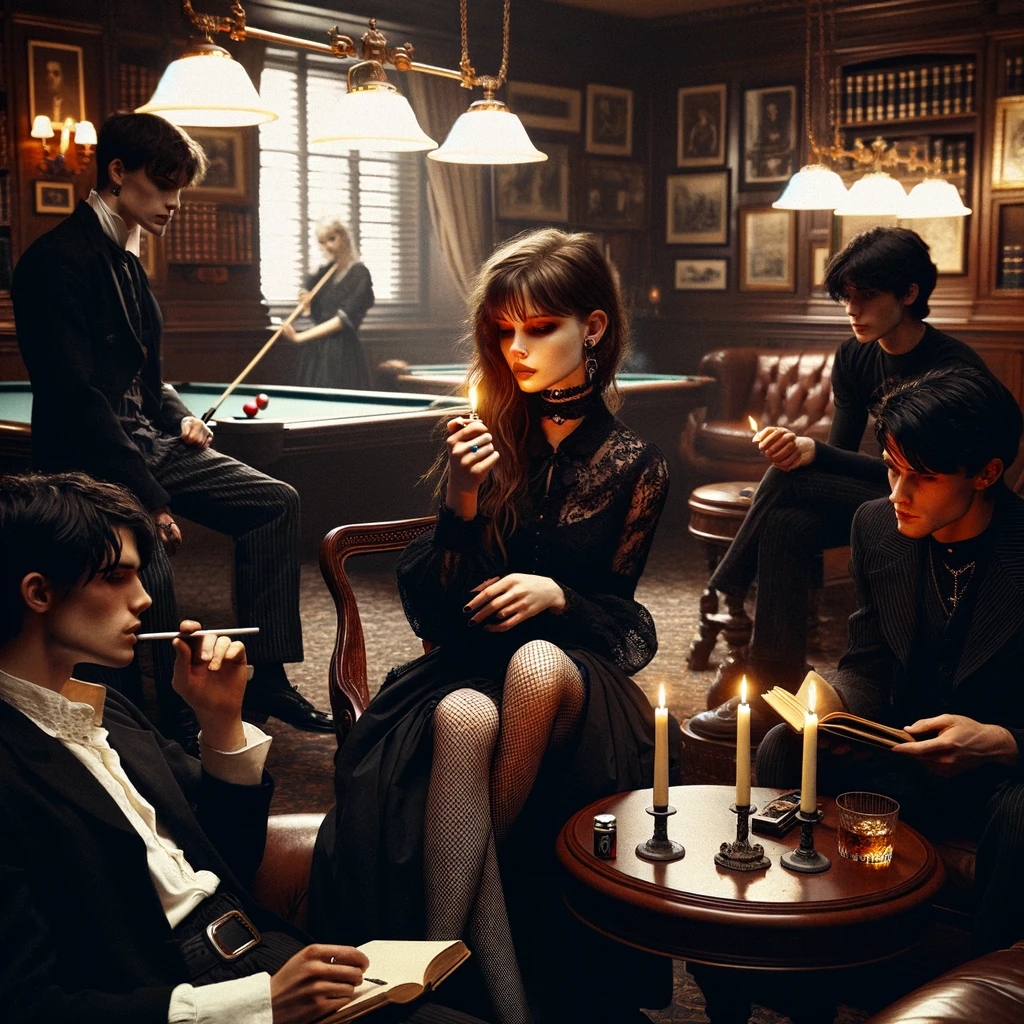
In the velvet darkness of Chuck’s father’s basement bar, Trish, draped languorously over the leather armchair, voiced the malaise of the privileged youth. The room, lit by the soft glow of antique lamps, flickered as she ignited her cigarette, the smoke wafting upwards, mingling with the existential ennui that seemed to be their constant companion.

“I am so fucking bored,” she announced, her voice laced with the kind of weariness that comes not from hardship, but from too many days steeped in unchallenged comfort. The ember of her cigarette glowed brighter as she inhaled, a beacon of her frustration. “Well, here we are in the midst of the bullshit.”

Drake, leaning against the pool table, a book of Burroughs’ prose forgotten in his hand, looked up and caught the scent of Trish’s discontent. “Where are we going?” he mused, not so much a question as a philosophical pondering. “This country is so fuckin’ dismal.”

In the corner, Angela lowered her eyes from the abstract painting she was sketching, her pen pausing mid-stroke. “Maybe the country mirrors us, maybe we mirror it. Dismal and brilliant, depending on where you’re standing,” she said, her voice a soft counterpoint to Trish’s sharpness.

Chuck swirled the ice in his whiskey glass, the clink of cubes a punctuation to the dialogue. “Perhaps it’s not about where we’re going, but what we’re willing to see along the way,” he suggested, his gaze fixed on the liquid amber, contemplating his own reflection.

The room fell silent, save for the hiss of Trish’s cigarette and the soundtrack of The Cure playing low on the stereo. Each friend was alone with their thoughts, yet united in their shared search for meaning in an age that promised so much and yet often delivered so little.

In this moment, they were the emblems of their generation – affluent, educated, and disenchanted, standing at the precipice of adulthood, unsure whether to leap or to build a bridge to a future they couldn’t yet fathom.

Holy cow, I can’t believe this works this well

Unedited Chat-GPT:

In the dimly lit confines of Alvin’s sumptuously decorated drawing room, a space where every artifact seemed to whisper tales of forgotten epochs, Drake, with his dark hair falling loosely over his intense eyes, leaned forward. His friends, the Sickie Souse Club, lounged around him, each absorbed in their own thoughts yet united in their shared disillusionment.

“The truly dramatic gesture is being lost from society,” Drake declared, his voice tinged with a mix of passion and despondency. “Our entertainment business is completely toxic.”

Graylyn, seated across from him, her artist’s hands folded in her lap, raised an eyebrow. “But isn’t that just evolution, Drake? Art changes with time.”

Drake shook his head, vehemently disagreeing. “It’s not evolution, it’s erosion! The industry chases profit, not artistry. The depth, the soul of what we once revered in literature, in music, it’s being diluted.”

Chuck, who had been quietly nursing a drink, chimed in, “Well, it’s the market, Drake. It’s always been about what sells.”

Patricia, whose elegant poise often masked her inner turmoil, looked at Drake, her eyes reflecting a shared sense of loss. “But don’t you think there’s still hope? There are still artists who believe in the power of a message, in the magic of words.”

Drake leaned back, a distant look in his eye. “Yes, Trish, but they’re like voices in a storm. Overwhelmed by the noise, the endless, trivial noise.”

Dustin, ever the rationalist, adjusted his glasses. “Perhaps it’s not about the gesture being lost, but about us finding new ways to interpret and interact with these gestures. The digital age has changed the landscape.”

Angela, with her innate optimism, added, “Change doesn’t have to mean the end, Drake. It could be a beginning. Maybe we just need to look harder, listen more closely.”

Drake sighed, feeling the weight of his idealism. “Maybe. But I fear that as we step into this new age, we’re leaving behind the raw, unfiltered essence of what makes art truly transformative.”

The room fell into a contemplative silence, each member of the Sickie Souse Club wrestling with their own visions of an era that seemed to be slipping away. In their hearts, they knew Drake’s lament was not just for art, but for a part of themselves, a youthful innocence that was being challenged by the harsh realities of a world in flux.

Sunday Bloody Sunday

In the dimly lit Denny’s, where the clock nudged past 2 AM, the Sickie Souse Club found themselves in a heated debate, their voices a symphony of conviction and playful accusation. At the heart of the dispute was U2’s music video “Sunday Bloody Sunday,” and whether its raw emotional power was genuine or just cleverly crafted artifice.

Angela, her eyes reflecting the neon lights outside, defended the video with a passion that betrayed more than just artistic appreciation. “It’s not just a song, it’s a political statement,” she insisted, her voice rising above the clatter of late-night diners. “Bono’s not just performing; he’s emoting the pain and struggle of an entire generation.”

Drake, lounging back in the booth with a look of amused skepticism, teased, “Oh, come on, Angela. It’s all theatrics. Bono’s just a rock star playing his part.”

The others chimed in, some siding with Angela’s view of authenticity, others echoing Drake’s cynicism. Amidst the banter, Graylyn, her eyes gleaming with mischief, leaned forward, “And let’s not ignore the elephant in the room. Angela, you just have a massive crush on Bono, don’t you?”

Angela’s cheeks flushed a shade of crimson that could rival the diner’s neon sign. “That’s ridiculous,” she retorted, but her voice lacked conviction, and a shy smile played on her lips.

Trish, twirling a strand of her hair, added fuel to the fire, “It’s okay to admit it, Ange. He does have that charismatic rebel vibe.”

Alvin, always the peacemaker, interjected, “Whether it’s love for Bono or not, Angela does have a point. Music and politics have always been intertwined. Think of Dylan, think of Lennon. Bono’s just carrying the torch.”

Dustin, who had been quietly observing the conversation, offered a philosophical perspective. “Authenticity in art is subjective. What matters is the impact it has on the viewer, or in this case, the listener. Angela sees sincerity; Drake sees a performance. Both views are valid.”

As the conversation ebbed and flowed, Charles, who had been amusingly watching the debate, finally spoke, “Regardless of the argument, this is exactly what makes music powerful. It’s not just the melody or the lyrics; it’s the emotions and discussions it sparks.”

As dawn’s early light began to seep through the diner’s windows, the Sickies’ debate simmered down, leaving behind a tapestry of laughter, half-eaten pancakes, and the warmth of friendship. They might not have resolved the authenticity of “Sunday Bloody Sunday,” but in that moment, their bond, much like the music they debated, was undeniably real.

The Music of the Night

Unedited Chat-GPT:

In the hushed confines of a classroom long abandoned by the day’s curriculum, Trish and Angela found themselves adrift in a quiet act of rebellion. The sun had already begun its descent, casting a golden wash over the otherwise sterile room. It was here, amidst scattered desks and chairs, that the ritual of transformation took place.

Trish, draped in the elegance of sheer black, her fingers deft and precise, was the artist, and Angela, her canvas, sat with an ethereal patience that only those touched by the muses possess. The gentle bristles of the makeup brush danced across Angela’s features, a conductor orchestrating the symphony of shadows and light.

“You need to look the part if you’re going to the concert with us tonight,” Trish whispered, her words as soft as the strokes she applied. “The Cure wouldn’t have it any other way.”

Angela’s lips curled into a smile, her eyes closed in trust. “I’ve never done anything like this,” she confessed. “My brothers would never understand.”

Trish paused, her hands cradling Angela’s face, “Forget them. Tonight, you’re not the Colonel’s daughter or the track star. You’re a siren of the night, a creature of beauty and mystery.”

In the quiet, the only sounds were the distant hum of the city and the rustle of Trish’s dress as she worked. Angela, transformed under Trish’s ministrations, began to embody the spirit of their endeavors, the freedom that came with the disguise of the night.

The bell tolled, signaling the end of an invisible boundary. The two stood, a moment frozen in time, as Angela glanced at the mirror. She no longer saw the disciplined athlete; instead, a rebellious spirit gazed back, ready to taste the forbidden fruits of the night.

“Ready?” Trish asked, her voice a gateway to the night’s adventures.

Angela nodded, her transformation complete. As they walked out, leaving the safety of the classroom and the expectations of their daylight personas behind, they stepped into the neon-lit promise of the evening. The Sickie Souse Club was more than a group of friends; it was a declaration of independence, a rebellion against the mundane, and tonight, Angela felt the pulse of that defiant spirit for the very first time.

“This is your Woodstock.”

In the dimly lit ambiance of Denny’s at 2 am, the Sickie Souse Club gathered around their usual corner booth, a sense of disillusionment hanging in the air as they discussed the aftermath of Live Aid.

Drake, with his enigmatic aura, broke the silence first. “You know, Live Aid, despite its grandeur, felt overrated to me,” he said, a hint of cynicism in his voice. “It was like watching popular culture being sanitized, stripped of its raw, authentic edge.”

Trish, her slender fingers wrapped around a mug of tea, nodded pensively. “I agree. There was something unsettling about it. Like it was more of a spectacle than a genuine movement for change. It felt… performative.”

Chuck, reclining with his usual nonchalance, added, “Exactly. It was like everyone was there more for the show than the cause. The real issues got lost in the glitter and glam of celebrity.”

Dustin, peering over his glasses, reflected, “It’s a paradox, isn’t it? A concert meant to highlight suffering, yet it felt so distant from the harsh realities of the world.”

Graylyn, her artist’s eyes filled with a critical light, said, “It’s the commodification of activism. Turning empathy into entertainment, that’s what it was. The true message got diluted.”

Angela, her optimism slightly dimmed, sighed. “I wanted to believe in it, I really did. But there was this nagging feeling that it was just a temporary high for the masses, a fleeting sense of unity.”

Alvin, his mystical demeanor somewhat shadowed, leaned in. “It’s like watching a mirage of hope, a beautifully orchestrated illusion. We’re left wondering, what now? What’s the next step after the applause dies down?”

The conversation ebbed and flowed, their voices a chorus of disenchantment. In that small corner of Denny’s, they shared a moment of collective introspection, pondering the complexities of popular culture and the elusive nature of genuine change.

As the night deepened and their coffee cups emptied, they each grappled with the ambiguous feeling that lingered, a sense that the world was shifting beneath their feet, leaving them yearning for something more profound than what the mainstream could offer.